China’s military shared footage this week showing a rapprochement between its aircraft carrier group and a Japanese warship in the Western Pacific Ocean. Such interactions in international waters between Chinese and Japanese forces have grown common. China’s expanding navy frequently conducts exercises beyond its coastal waters and what U.S. defense planners refer to as the first island chain.
The Chinese military accused Japanese military ships and planes of “close-in tracking, surveillance, harassment, and provocations” during the Liaoning carrier group’s over 40-day deployment in the South China Sea and the Philippine Sea. According to a statement, elements of the Chinese carrier group managed Japan’s “dangerous actions” professionally. The Japanese government has not offered a public response, and Japan’s Defense Ministry did not respond immediately to a written request for comment.
The incident arises amid tensions between Beijing and Tokyo over Japan’s military modernization efforts with U.S. support. China warns that such efforts hint at a return to Japan’s past militarism. The Soviet-built Liaoning is China’s first operational aircraft carrier and has been active since 2012. China released the undated video on Monday as the Liaoning returned from its “far-seas combat training” to its East China Sea home port, Qingdao.
Chinese state media released footage of the Liaoning carrier group shadowed by the Japanese destroyer JS Asahi, with Japanese navy patrol planes flying overhead. The Joint Staff Office of Japan’s Defense Ministry reported that its forces monitored the initial elements of the Chinese carrier group as they entered the Philippine Sea in mid-May. The Liaoning and its escorts joined later in the area, according to a separate press release.
In early June, another report noted the Liaoning strike group conducted numerous carrier jet and helicopter operations in waters east of the Philippines. On Monday, the office confirmed the Japanese destroyer Asahi being among the units monitoring Liaoning as it returned to the East China Sea on June 20.
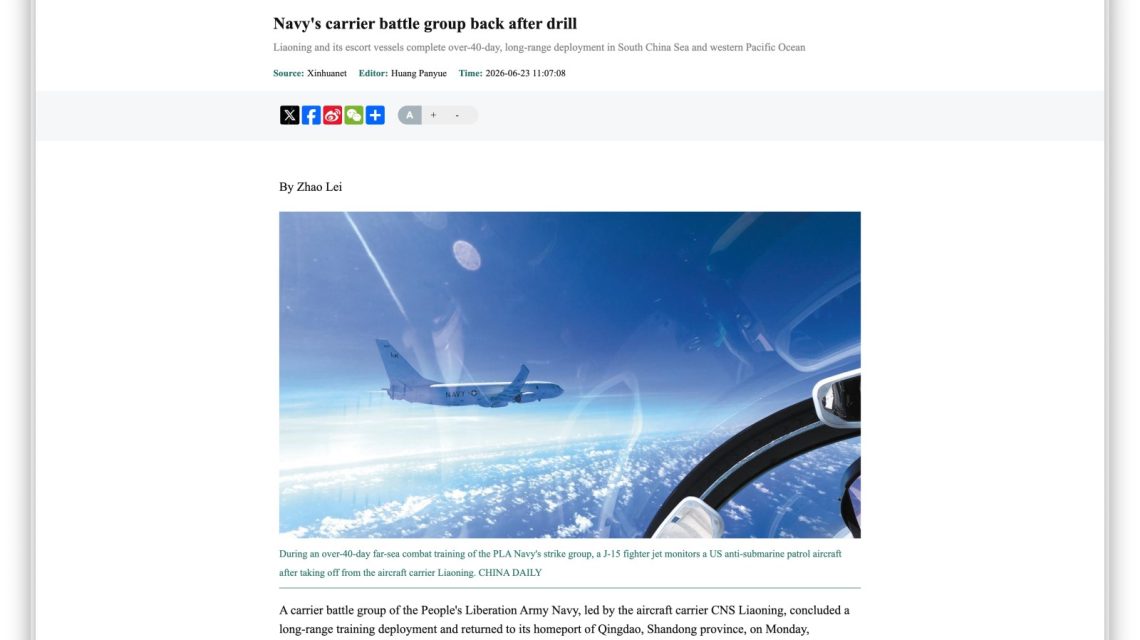
A report from China Daily, republished on the Chinese armed forces’ official English-language portal, included a photo of a Chinese fighter jet encountering a U.S. Navy P-8A Poseidon maritime patrol plane. The caption stated, “[A] J-15 fighter jet monitors a U.S. anti-submarine patrol aircraft after taking off from the aircraft carrier Liaoning.” No date accompanied this encounter, nor was it mentioned in Chinese military press releases. The Hawaii-based U.S. Pacific Command didn’t provide a comment in response to an email request after hours.
This was the Liaoning’s first deployment in wider Pacific waters since December. One year ago, China deployed the Liaoning alongside the Shandong, its second operational aircraft carrier, in the Philippine Sea. The Chinese military declared the latest deployment included combat exercises, carrier aircraft flight drills, and search and rescue training.
The training is described as a routine exercise within China’s annual plan, aiming to boost its mission capabilities. According to the Chinese navy, it complies with international law and practice and targets no specific country or objective.
 British Police Arrest Man Suspected of Terror Plot
  Activists Push for Nationwide Ban on Child Marriage in the U.S.
  Investigation into Alleged Incident at Cornell University
  Rising Drone Threats Highlight Vulnerabilities in Moldova’s Airspace Defense
  Bolivia Faces Security Test Amid Unrest
 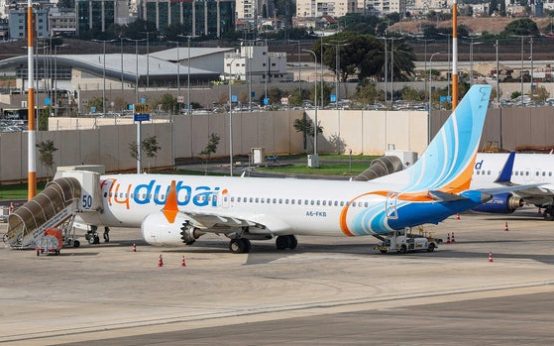 Incident on FlyDubai Flight Raises Security Concerns