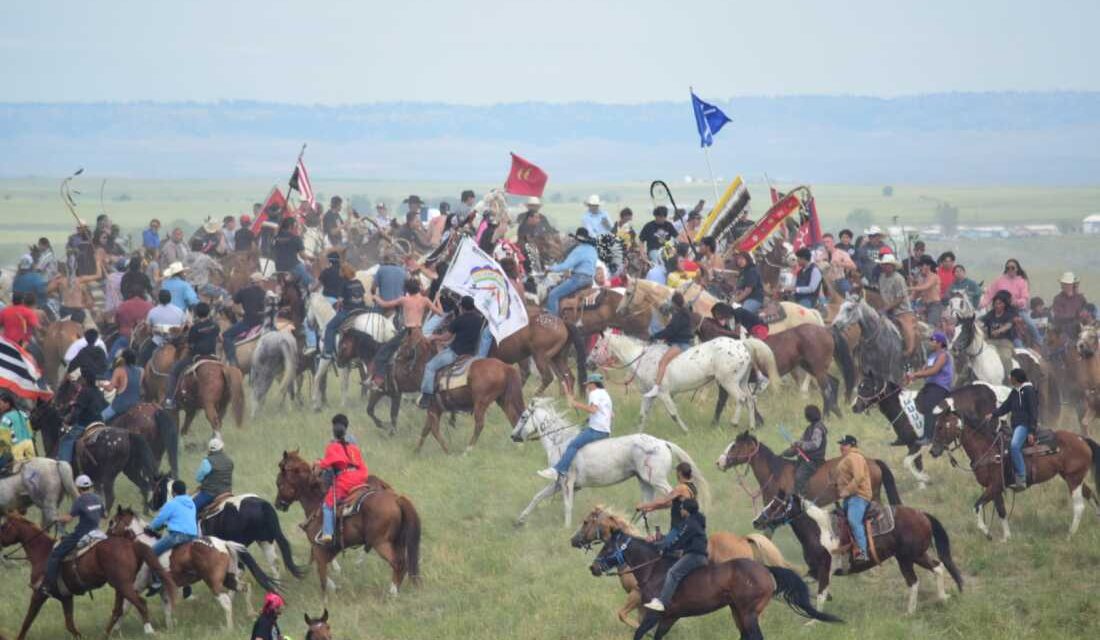
CROW AGENCY, Mont. — Beneath Montana’s vast sky, members and descendants of 19 tribal nations gather at a historic battlefield. They come to witness Native American riders on horseback revisiting the land where, 150 years ago, their ancestors triumphed over the U.S. Army’s 7th Cavalry led by Lt. Col. George Armstrong Custer.
The riders, some in traditional regalia and others in casual attire, dash across the arid landscape. They circle a hill at the Little Bighorn Battlefield National Monument. Many carry tribal flags, symbolizing the unity that enabled their ancestors’ swift victory on June 25, 1876.
It was important then, 150 years ago. It’s important today still,stated Gaby Strong, of Sisseton-Wahpeton and Mdewakanton heritage.Our victories are still possible.
Custer aimed to confine Native Americans to reservations. Following the 1874 gold discovery in the Black Hills, Indigenous peoples were instructed to report to U.S. field offices, facing hostility otherwise. Native leaders, including Crazy Horse and Sitting Bull, united tribes in resistance. Several clashes occurred in present-day Montana and South Dakota as military forces attempted to push remaining groups onto reservations.
Christopher Eagle Bear, Sicunga Lakota from the Rosebud Sioux Tribe, explained how leaders like Crazy Horse visited different bands to rally them for a greater cause. In 1876, Custer pursued a nomadic village of mixed tribes, including the Oceti Sakowin (Sioux), Cheyenne, and Arapaho, supported by Arikara and Crow scouts.
Custer, dividing his 700 men, hoped to encircle the village. By June 25, the settlement had grown to approximately 8,000 people. Custer attacked preemptively to prevent the tribes’ dispersal—a decision leading to his defeat.
It was early morning, they were camped. Then all of a sudden they’d seen Custer’s platoon coming over the ridge,Eagle Bear recounted, referring to the Lakota’s Battle of Greasy Grass.
By the battle’s conclusion, Custer’s forces were decimated, with 268 out of 700 men killed, including Custer himself. Fewer than 100 Native Americans, including women and children, were killed. The defeat caused nationwide shock, prompting the U.S. government to revise its Indian policy, moving towards forced assimilation. Three years later, the first off-reservation federal Indian Boarding School opened in Carlisle, Pennsylvania, initiating a century of cultural repression.
They realized that they couldn’t destroy us head-on. So after that, they did the next best thing that you could do to tear apart a nation, and that was take away the children,observed Eagle Bear.
Youth Leadership and the Legacy
During the 150th anniversary commemoration, people dismantle tipis at an encampment by the Little Bighorn River. The gathering unites tribal members from across the Plains for ceremonies, storytelling, and remembrance.
Eagle Bear camps at the historic site, coordinating the Rosebud Sioux Tribe’s presence, while setting a precedent for future generations. Someday, the kids here today will return for the 200th anniversary and discuss their experiences,
he anticipated, expressing gratitude for the youth’s involvement.
Nearby, children engage in traditional lacrosse amid drumming sounds. The Sicunga Youth Council provides meals for the camp, having planned the commemoration for eight months.
Ashlen Bonshirt, a youth council member, noted the thorough planning involved. We organized lacrosse, yoga, and many activities for our youth,
she explained. But logistical challenges like garbage and showers required planning too.
The camp brims with young participants, eager to learn about the battle’s untold stories. Gianna Larocque-Mahto, 13, voiced frustration about the one-sided historical narratives taught in schools. We only learned one perspective,
she lamented. It’s vital to understand all people’s perspectives.
Champion Marquez, an 18-year-old Cheyenne, volunteers at the camp, aiding elders and organizing tipis. The commemoration instills hope for him, seeing new generations recount the Battle of Little Bighorn.
Hope that many generations will understand what happened,
he said. Seeing children enjoying themselves and the efforts made for them reassures me that we’re still here.
 Readers React to Miss Manners Column
  Troy Swanson: Award-Winning Librarian Transforming Academic Libraries
  Lisdoonvarna Matchmaking Festival: A Unique Tradition
  Possible 19th-Century Shipwreck Exposed by Nor’easter in Nantucket
  Midwest Underground Railroad Network Gains National Recognition
  Art Collective Critiques Administration with Mall Installation