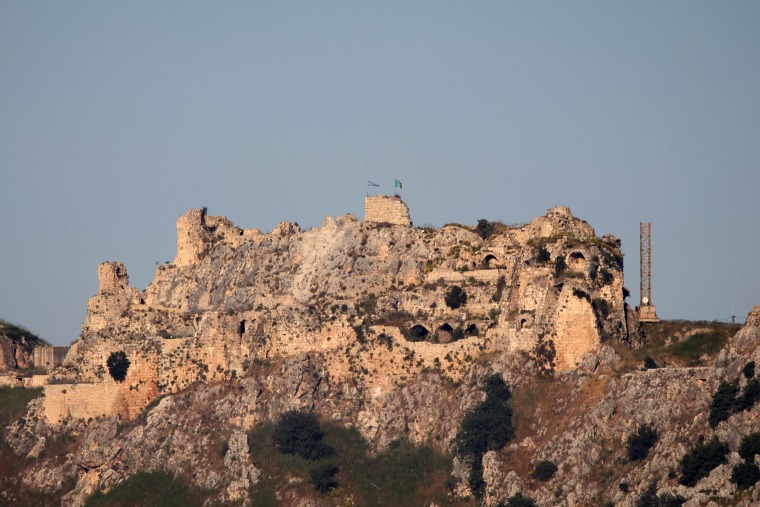
Israeli forces have advanced significantly into Lebanon by crossing the Litani River and seizing a key location, according to Defense Minister Israel Katz. This marks Israel’s most significant penetration into Lebanon in 26 years. The strategic capture of Beaufort Ridge, a site of a medieval castle, follows intense clashes in southern Lebanon.
Prime Minister Benjamin Netanyahu emphasized an increase in military operations in Lebanon, despite a ceasefire agreement established in April. The recent actions occur amid efforts led by the U.S. to foster peace between Israel and Lebanon, with officials from both countries attending talks in Washington.
“The Israeli flag is once again flying over the peaks overlooking the communities of the Galilee,” Defense Minister Katz stated. He noted that troops will remain at Beaufort as part of the security zone in southern Lebanon. Katz asserted on social media that Israel is focused on quashing Hezbollah.
UNESCO had expressed concerns over hostilities near Beaufort Castle, which holds provisional protected status. The agency called for the highest level of legal protection for such historical sites.
This significant crossing and capture signify an escalation in the conflict. The Litani River has served as a significant boundary since Israel’s prior invasions, with Israel taking control of areas south of the river and displacing local populations. Israel’s military attributed the destruction of bridges over the Litani to efforts by Hezbollah to transport weapons and militants.
Some factions call for Israel to maintain control of territory south of the river, citing security benefits. Israel’s Finance Minister Bezalel Smotrich described the capture of Beaufort Ridge as correcting historical mistakes and advocated for permanent occupation.
Fawaz Gerges from the London School of Economics warned about the potential for Israel to become embroiled in a prolonged conflict in Lebanon. He noted continued Hezbollah resistance, stating that despite Israel’s military might, promised security remains elusive.
Netanyahu visited the northern border, commending the military’s achievements. He highlighted operations across various regions, including Beirut and the Bekaa, as having a significant impact on Hezbollah.
Israel’s National Security Minister Itamar Ben Gvir urged for further action in Beirut. The conflict represents the gravest spillover of the Iran war, with over 1.2 million Lebanese displaced since March. Israeli strikes have resulted in over 3,350 Lebanese casualties, as per Lebanon’s health ministry, while Israel reports casualties among its soldiers and civilians.
Lebanon’s Prime Minister Nawaf Salam criticized Israel’s military actions, viewing them as collective punishment that contravenes international norms. The violence coincides with U.S. and Iranian negotiators striving to extend a ceasefire in their ongoing conflict, with Iran insisting that any ceasefire must address the war in Lebanon.
A senior Arab official indicated that a truce had been established but, pending finalization, remains conditional. U.S. Defense Secretary Pete Hegseth expressed that a comprehensive deal with Iran remains a priority.
Gerges commented that the escalation in Lebanon jeopardizes any potential agreement between the U.S. and Iran, asserting that only intervention from President Trump might sway the outcome.
 British Police Arrest Man Suspected of Terror Plot
  Activists Push for Nationwide Ban on Child Marriage in the U.S.
  Investigation into Alleged Incident at Cornell University
  Rising Drone Threats Highlight Vulnerabilities in Moldova’s Airspace Defense
  Bolivia Faces Security Test Amid Unrest
  Incident on FlyDubai Flight Raises Security Concerns