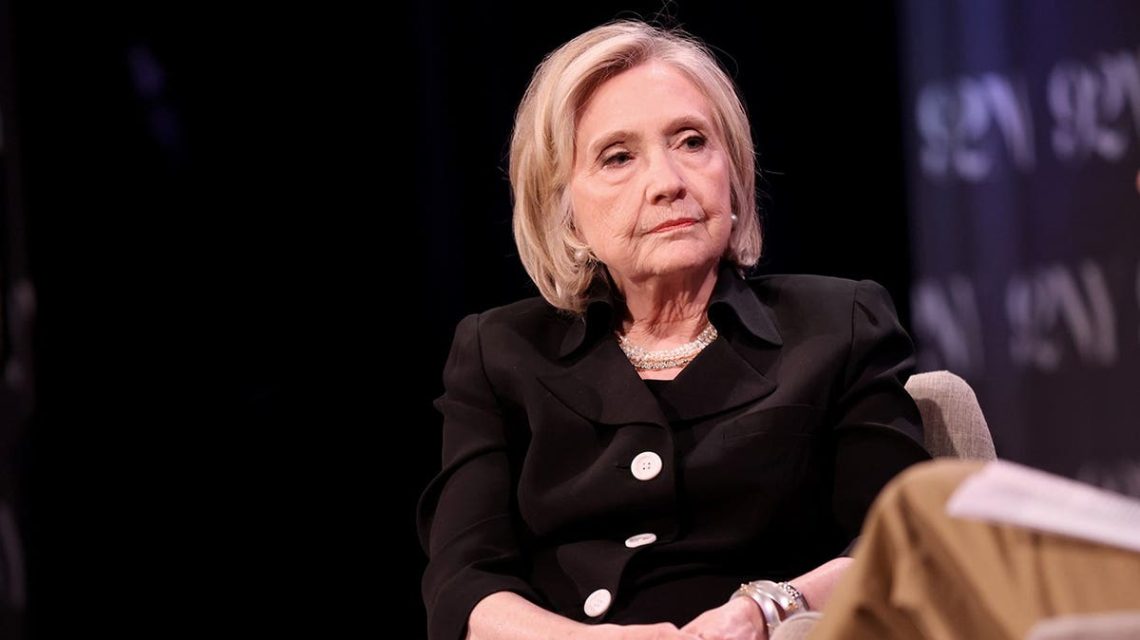
During a recent event in New York City, Hillary Clinton, former Secretary of State, expressed unexpected support for President Donald Trump’s management of the Israel-Hamas conflict. This moment of praise arose as Clinton conversed with David Remnick of The New Yorker at 92NY. Their discussion spanned topics from the Israel-Iran situation to President Joe Biden’s re-election bid.
When Remnick addressed the ongoing Israel-Hamas conflict, he questioned Clinton’s long-standing advocacy for a two-state solution in the region. He observed that neither Israeli nor Palestinian parties currently seem open to this solution, noting:
“But if I look at the Israeli polity, they don’t want a two-state solution, certainly not now. And if you look at the Palestinian polity, which is an even more complicated set of geographies and population, a two-state solution is not anywhere near the offing there,” Remnick said.
Clinton responded by surprisingly endorsing Trump’s 20-point plan for Gaza, which she described as potentially beneficial for securing Israel, reconstructing Gaza, and offering self-determination to Palestinians. She said:
“Trump’s 20-point plan for Gaza is actually a pathway to security for Israel, reconstruction for Gaza, and the possibility of self-determination — however defined — for the Palestinians. There are a lot of people who reject it because Trump did it, but it’s the only game in town. There’s nothing else.”
Clinton believes that sincere implementation of Trump’s plan could feasibly end the conflict overseas. She stressed the importance of its comprehensive execution, starting with disarming Hamas, and its potential for a viable solution. Clinton stated:
“But if you really took the whole approach that is embodied in that 20-point plan — and I know there are people who are working to try to move forward on that — there is a glimmer of a possible path forward.”
The 20-point plan, introduced last year, outlines various measures such as winning amnesty for Hamas militants who commit to nonviolence and transforming Gaza into a commercial hub. Under this proposal, military actions would cease immediately if both parties agree, leading to Israeli withdrawal and preparation for hostage release.
In January, U.S. Special Envoy to the Middle East Steve Witkoff announced the commencement of the plan’s second phase. This phase focuses on moving from ceasefire to demilitarization, governance, and regional reconstruction. Furthermore, the Trump administration established a Board of Peace to provide oversight and resources for Gaza’s transition to peace and development.
 The Trump Team’s Challenge to the Military Leadership
  Maryland First State to Restrict Electronic Pricing in Grocery Stores
  Activists Push for Nationwide Ban on Child Marriage in the U.S.
  Democratic Hopes and Historical Warnings in 2026 Senate Race
  Republicans Face Challenges Amidst Cost of Living Concerns
  A Different Kind of Fall for Congress This Year