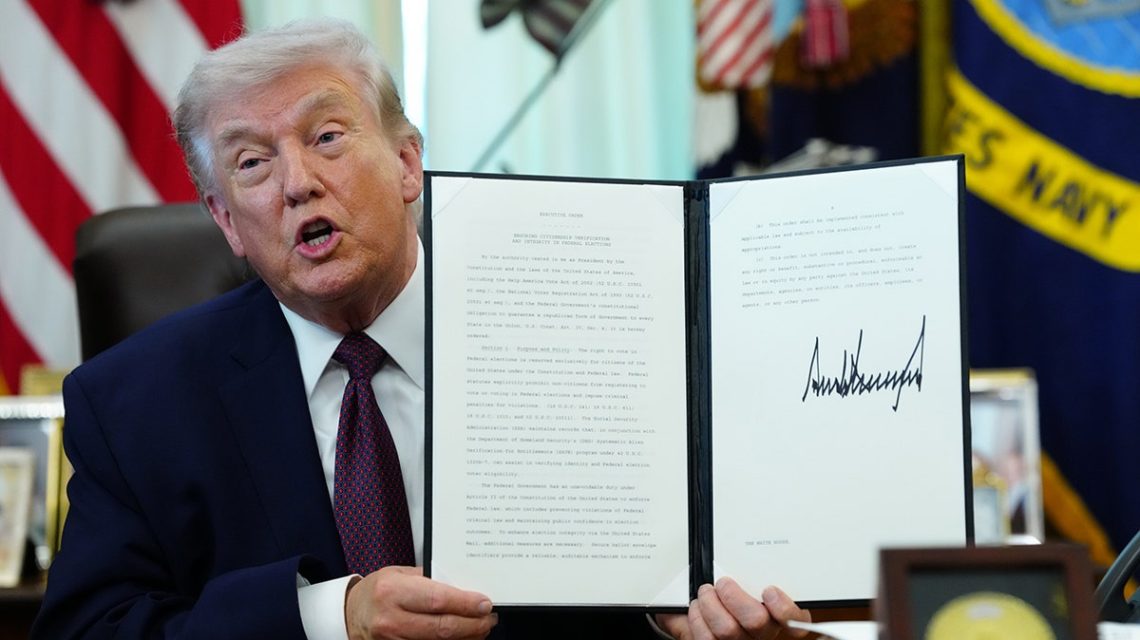
President Donald Trump faces legal challenges regarding the implementation of new federal mail-ballot rules prior to the 2028 presidential election. Legal experts have expressed concerns about whether his administration can proceed with these changes.
In March, President Trump issued an executive order directing the Postal Service to develop standardized rules for federal mail ballots. This included standardized ballot envelopes with an Official Election Mail designation and unique machine-readable barcodes. According to the order, the Postal Service could reject ballots that do not comply with these standards or belong to individuals not listed as eligible mail voters.
On September 14, the Supreme Court maintained a preliminary injunction preventing the implementation of these rules before November’s midterm elections. This leaves uncertainty about whether the changes may be applied before the 2028 election.
Legal experts argue the decision will revolve around the Supreme Court’s interpretation of authority between the executive branch’s regulation of mail and states’ rights to administer elections.
According to Florida State University law professor Michael Morley, if the court sees this as an attempt to regulate federal elections, it may invalidate the rule. The President lacks constitutional authority over federal elections, and Congress hasn’t granted him extensive statutory powers. However, if viewed as administrative requirements for efficient postal operations, the rules might be upheld.
The Supreme Court, by a 7-2 margin, upheld the injunction, blocking the order from affecting the midterms. Justices Clarence Thomas and Samuel Alito dissented. Justice Brett Kavanaugh supported the injunction, noting that implementing such regulations close to an election violates federal law, despite the Postal Service’s potential authority to enact such rules.
Legal fellow Stephen Richer from the Cato Institute predicts the administration might lose on the merits, as the Constitution doesn’t grant election regulation power to the President. It delegates authority to Congress and the states.
Others emphasize procedural aspects rather than rejecting the administration’s efforts outright. America First Policy Institute senior legal fellow Chad Mizelle highlights Justice Kavanaugh’s belief in the Postal Service’s authority and cites timing as the primary barrier to implementing the rules before the midterms.
Despite the legal setbacks, President Trump views the injunction as a significant defeat for his administration’s goal to regulate mail voting.
Cases of election and mail-ballot fraud exist individually but do not prove widespread fraud in U.S. mail voting.
The matter of who establishes mail voting rules—whether it’s the state, Congress, or a federal agency—remains unresolved.
The White House did not respond to requests for comments regarding these developments.
 The Trump Team’s Challenge to the Military Leadership
  Maryland First State to Restrict Electronic Pricing in Grocery Stores
  Activists Push for Nationwide Ban on Child Marriage in the U.S.
  Democratic Hopes and Historical Warnings in 2026 Senate Race
  Republicans Face Challenges Amidst Cost of Living Concerns
  A Different Kind of Fall for Congress This Year