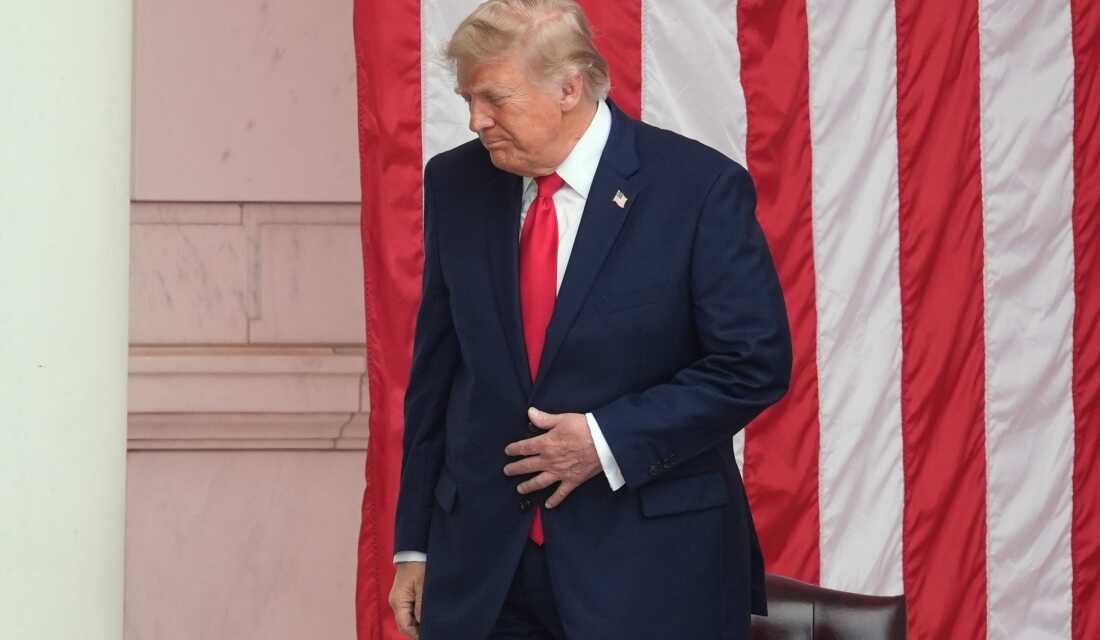
President Donald Trump spoke at the 158th National Memorial Day Observance at the Memorial Amphitheater in Arlington National Cemetery on May 25, 2026, during the nation’s 250th-anniversary celebration in Arlington, Virginia.
On Tuesday, President Trump has a scheduled visit to the Walter Reed National Military Medical Center. This will be his third visit in the past 13 months, prompting concerns about his health. The White House announced this visit as a “routine annual dental and medical assessment” as part of his preventive healthcare.
At 80 years old, Trump stands as the oldest person to have taken the oath of office, second in age only to President Joe Biden. His physical appearance, such as swollen ankles and bruised hands, has led to repeated questions regarding his health and ability to serve.
Trump’s most recent annual physical examination occured in April of last year. He later claimed to have “aced” a cognitive test, and a White House memo described him as being in “excellent health.” A follow-up visit to Walter Reed in October led to further speculation, especially after a CT scan assessed his “cardiovascular and abdominal health.” White House physician, Capt. Sean Barbabella, declared Trump’s health as “excellent overall.” Despite this, questions lingered due to visuals showing makeup covering bruised hands and occasional lethargy during public appearances.
Trump addressed the scrutiny in January by explaining to the Wall Street Journal that he regretted the October CT scan due to resultant speculation and attributed the bruising to excessive aspirin intake.
Mental and physical fitness have been significant themes in Trump’s political narrative, particularly during his campaign against Joe Biden, whom he often depicted as lacking the capacity to be Commander-in-Chief. Biden withdrew from the presidential race in June 2024, shortly after a debate with Trump.
The White House has consistently defended Trump’s vigor, frequently citing his busy schedule and interactions with press and world leaders. Recently, Communications Director Steven Cheung highlighted Trump’s lengthy work hours, emphasizing his dedication, especially during negotiations for a U.S.-Iran peace deal.
Throughout Trump’s second term, his cabinet members have also commented on his health. In a podcast, HHS Secretary Robert F. Kennedy Jr. stated that CMS Administrator Dr. Mehmet Oz reviewed Trump’s medical records and noted exceptionally high testosterone levels for someone over 70.
Presidents typically receive excellent preventive care and have frequent consultations with White House physicians. Visits to Walter Reed are commonly for annual physicals, advanced diagnostics, or significant illnesses, such as when Trump contracted COVID-19 in 2020.
There is a history of limited transparency concerning Trump’s health. In the summer of last year, he was diagnosed with chronic venous insufficiency, affecting blood flow to the heart, yet the White House maintained that his cardiovascular health was “excellent.” The most detailed recent medical report, from April 2025, mentioned “abnormalities” like scarring on his ear from an assassination attempt and a benign polyp found during a colonoscopy.
The report also showed Trump weighing 224 pounds, marking a 20-pound weight loss since 2020. His cholesterol levels were within optimal ranges. A memo from Dr. Ronny Jackson in 2024 following the assassination attempt described a head CT and Trump’s expected recovery.
In recent years, Trump presented a doctor’s note without detailed data, mentioning weight loss and exceptional cognitive performance. Earlier records from 2018, provided by Dr. Jackson, praised Trump’s “great genes.”
The White House did not provide detailed responses regarding Trump’s upcoming examination, only referring to a previous announcement of the Walter Reed visit.
An outside expert on cardiovascular medicine, Dr. Byron Lee from Stanford University, mentioned that annual physicals are standard at Trump’s age. He noted that active individuals often maintain their health well into their eighties.
Dr. Lee expressed interest in Trump’s aspirin use, as it’s not commonly recommended without specific risk factors and can cause bruising. He also highlighted the need to investigate Trump’s chronic venous insufficiency further, although it is not typically dangerous, it could indicate other underlying issues.
Lee suggests that Trump’s weight loss is beneficial, as being overweight increases heart disease risks. He suggests the use of medications like Ozempic for similar patients.
 U.S. States Extend Gas Tax Waivers Amid Rising Fuel Costs Due to Iran Conflict
  USCIS Raises Immigration Fees
  The Surveillance Threat to U.S. Federal Agents
  Trump Administration Distributes ACA Refund Checks
  Trump Administration’s Approach to Illegal Alien Deportations
  New Jersey Voter Fraud Prompts Renewed Push for SAVE Act