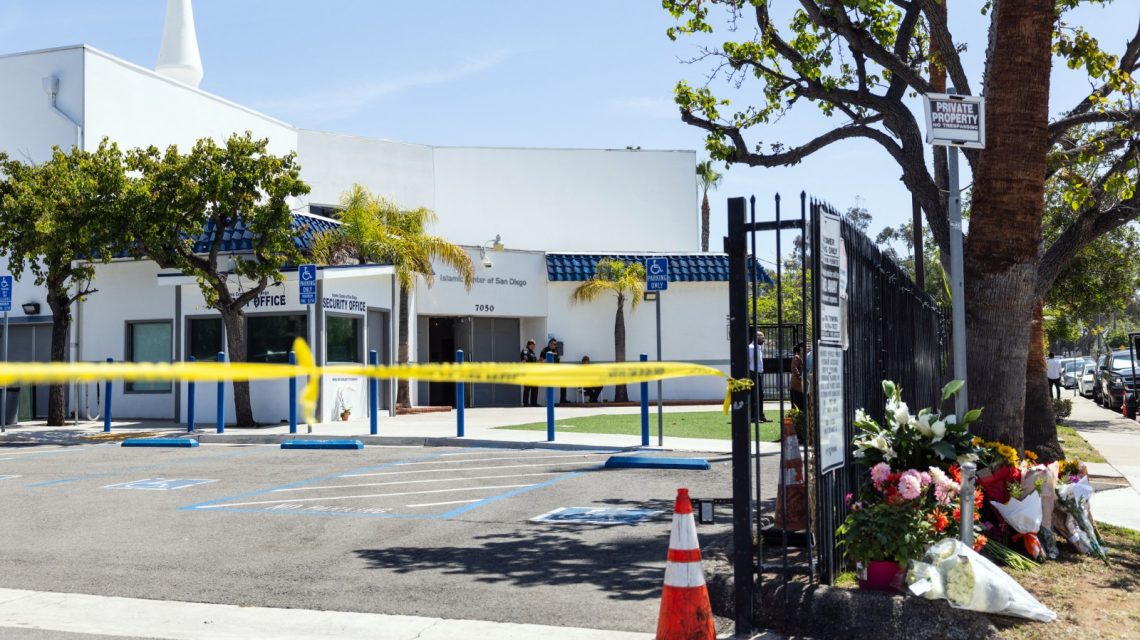
As Americans commemorate the 250th anniversary of the nation, discussions about freedom, pluralism, and the promise of religious liberty are abundant. A significant expression of this promise is George Washington’s 1790 letter to the Hebrew Congregation of Newport, Rhode Island. He pledged that the United States would “give to bigotry no sanction, to persecution no assistance.” Over two centuries later, it is crucial to assess our progress in fulfilling that ideal.
On the fourth Friday following the attack on the Islamic Center of San Diego, I attended prayers at a mosque in Los Angeles. There, five armed guards monitored over a thousand worshippers. Families brought children, friends exchanged greetings, and volunteers managed traffic. This level of security has become commonplace.
A few weeks earlier, my daughter visited from Canada and joined me for Friday prayer. She paused to photograph a security guard, noting his bulletproof vest and semiautomatic rifle. Her question, “Is this normal?” raised concerns, as the answer is yes. This routine has become troublingly familiar.
The San Diego attack resulted in the deaths of three individuals, including a security guard who died protecting the worshippers. Over 130 children were present that day.
According to the Center for Strategic and International Studies, the San Diego incident may be the first ideologically motivated lethal attack on a U.S. mosque this century. This marks a grim milestone resembling attacks in Christchurch, New Zealand, and Quebec City, Canada.
The Islamic Center was prepared. They had federal and state security funding, surveillance cameras, fences, bullet-resistant glass, trained staff, and emergency plans. Despite these precautions, the tragedy happened. These measures likely reduced the extent of the catastrophe but highlighted how such security precautions have become standard at American worship venues.
This security challenge extends beyond Muslims. Jewish, Christian, Sikh, Hindu, and other faith communities have experienced attacks, threats, and vandalism. Across these traditions, the question remains: how can these communities stay open and welcoming while ensuring safety?
Security expenses are high. Funding for guards, cameras, and assessments subtracts from resources available for education, charity, counseling, or community programs. After prayer, contributing to the donation box reminded me of this reality. Since the attack, I have doubled my contribution to help cover additional security costs. This shift in fundraising priorities from service to protection is notable.
The Muslim Public Affairs Council reports that attacks on Muslims have increased elevenfold. Yet, researchers from UC Berkeley’s Othering and Belonging Institute estimate that over 80 percent of anti-Muslim hate incidents go unreported. This suggests the issue is more extensive than official statistics indicate.
Fear is not always reflected in government data. Instead, it manifests in daily decisions: parents questioning their children’s safety at religious classes, worshippers assessing their surroundings before entering a house of worship, and community leaders debating security investments.
Security funding is significant. The California chapter of the Council on American-Islamic Relations questions whether Muslim-serving institutions get a fair share of nonprofit security grants amid rising threats. The focus should be less on the amount of security funding and more on why such precautions are increasingly necessary.
Post-9/11, Muslims in America have faced intense scrutiny. Mosques have been watched, vandalized, threatened, and sometimes attacked. Anti-Muslim conspiracy theories have shifted from the extremes to mainstream discourse. While most people exposed to such rhetoric don’t engage in violence, it shapes perceptions of belonging and suspicion. Violence often grows in an environment where fear and dehumanization become normalized.
The San Diego attack and the presence of armed guards are part of a broader context. As America celebrates its 250th birthday, it is important to honor the nation’s achievements, but also reflect. San Diego serves as a reminder that the focus is not solely on how Muslims protect mosques, but how America defends religious freedom as a whole.
The security issues facing mosques today affect all American worship communities. As religious groups feel the need to secure themselves more, the nation strays from Washington’s promise of giving “to bigotry no sanction, to persecution no assistance.” A quarter millennium after the founding, the vital question is not the number of guards or security measures, but why Americans increasingly feel unable to worship without them.
Faisal Kutty is a professor of law at Southwestern Law School, affiliate faculty at the Rutgers Center for Security, Race and Rights, and a contributing editor for the Washington Report on Middle East Affairs.
The views in this article are the author’s own.
 Cargo Plane Crash at Miami International Airport
  Marine Veteran Suing Oregon School District Over Curriculum Reimbursement
  Tennessee Execution Halted as Issues Persist with Lethal Injection Protocol
  Judge Dismisses Case Against Former Olympian Over Lincoln Memorial Incident
  Minnesota Family Files Civil Rights Lawsuit Over ICE Agent Shooting
  California Bans Child Marriage, Protecting Minors