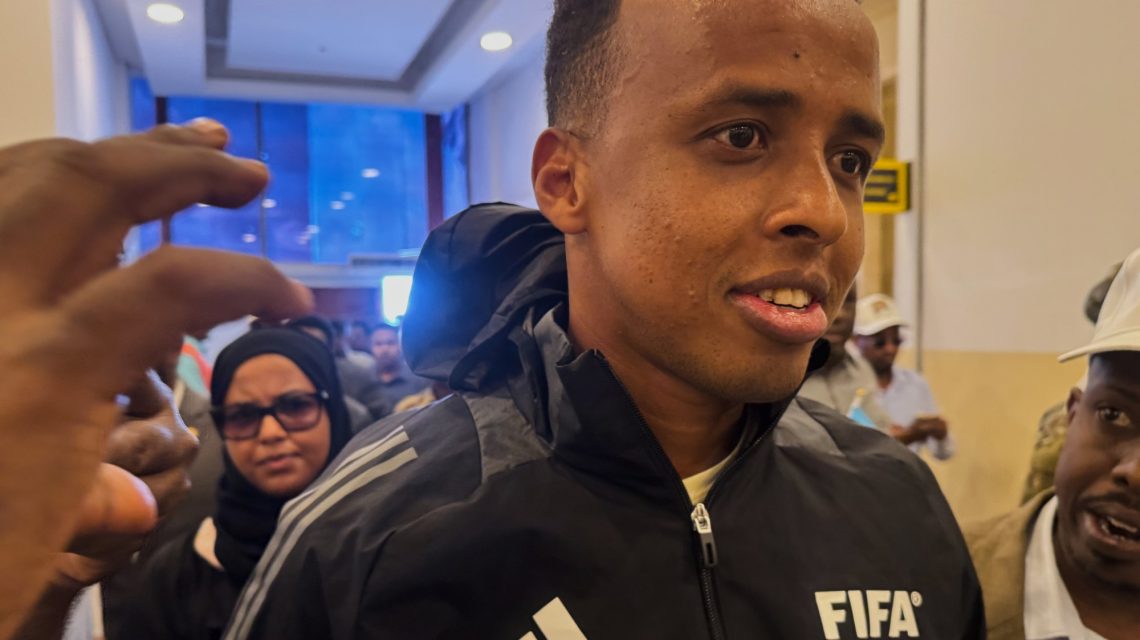
Referee Omar Artan, denied entry to the United States, was welcomed back to Mogadishu, Somalia, on Wednesday, June 10, 2026. Arriving at Aden Adde International Airport, he was greeted by a supportive crowd of officials and fans. Artan vowed to participate in the next World Cup, encouraging Somali youth to hold pride in their nation.
Artan was poised to become the first Somali referee at a World Cup after being selected for FIFA’s final list. Renowned as one of Africa’s leading referees, he was deemed the continent’s top male referee in 2025. However, he faced entry denial at Miami International Airport due to unspecified “vetting concerns,” as stated by U.S. Customs and Border Protection. Following this, FIFA removed him from the referee lineup for the tournament.
The denial occurred despite Artan receiving a visa processed by the Somalia Embassy in Kenya just a week prior. As one of the co-hosts with Mexico and Canada, the U.S. expected his presence in Miami for training with fellow World Cup referees. Nonetheless, his return to Somalia was marked by celebration, where he expressed gratitude to the Somali government, citizens, and FIFA for their support.
“I promise you, God willing, that I will attend the next one,” Artan stated, addressing the crowd waving Somali flags at the airport. “I want the Somali public to take comfort in this and remain confident.”
Somali Prime Minister Hamza Abdi Barre praised Artan, acknowledging his significant impact and historical contribution, by stating that Artan had “won the hearts of millions.” The Prime Minister noted that Artan’s commitment to fair play in football was evident despite the unfortunate outcome.
The U.S. decision to deny entry to a FIFA-approved referee prompted global outrage and raised concerns about the nation’s capacity to host the World Cup. Under stricter travel restrictions implemented by the Trump administration, Somalia is among nearly 40 countries affected. In response, the United Nations’ top human rights official advocated for reevaluation of immigration policies in anticipation of the World Cup.
Hundreds, including government representatives and members of Somalia’s football community, awaited Artan’s arrival. Upon his descent, he was surrounded by supporters waving Somali flags, later being wrapped in the national flag. His reception included an escort by police officers to the VIP terminal, where he addressed the press alongside dignitaries like Somalia’s sports minister.
“It is up to all of us to defend the Somali name,” Artan proclaimed. “Somalia belongs to us, whether it is in a bad state or a good state. That flag belongs to us, and that passport belongs to us.”
In a country scarred by prolonged conflict and insurgency, Artan’s rejection highlights both disappointment and aspiration. He exemplifies the potential for Somalis to pursue their dreams despite challenges. His anticipated inclusion in the World Cup was regarded as a victory by many, reinforcing the idea that his achievement signifies inspiration for future generations.
The World Health Organization’s Director-General Tedros Adhanom Ghebreyesus, from Ethiopia, emphasized Artan’s success in reaching the professional pinnacle and inspiring others, conveying on X that being sidelined doesn’t diminish his accomplishments.
 The Quest for the Knuckleball Dream
  Historical Events in Chicago on October 1st
  Stephen A. Smith Discusses Houston Texans’ Critical Matchup Against Dallas Cowboys
  CC Sabathia Anticipates Yankees’ Game 1 Pitcher for ALDS After Beating Red Sox
  Atlanta Dream Progress to WNBA Semifinals
  Los Angeles Lakers Focus on Defense in Luka Doncic Era