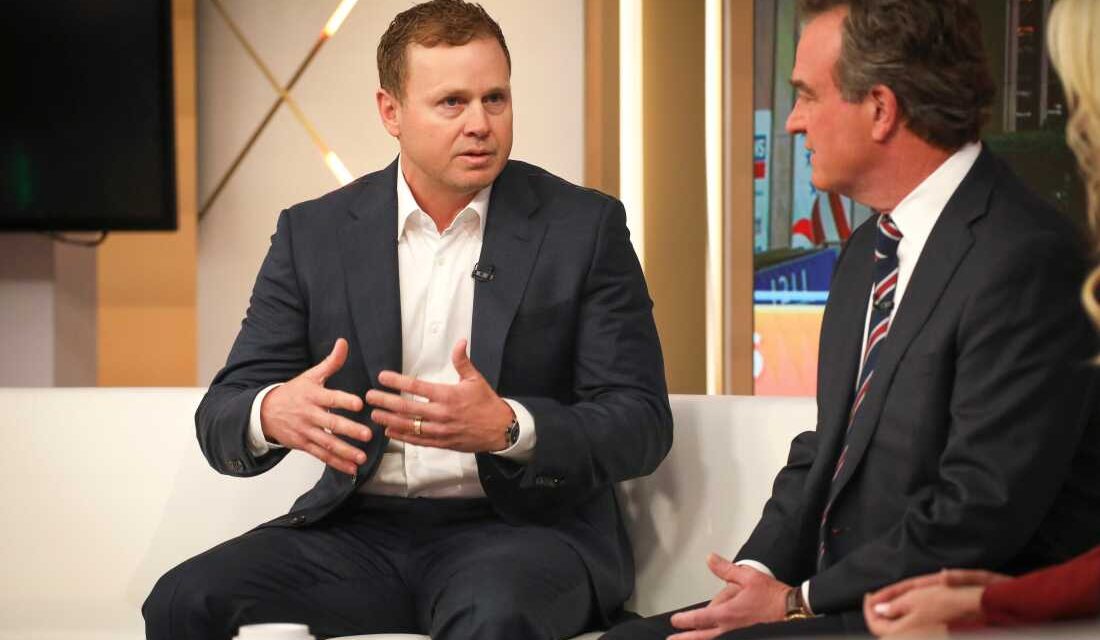
Spencer Pratt, well known for his role as a villain on the reality TV show “The Hills,” has taken the political stage in his bid to become the mayor of Los Angeles. His campaign strategy emphasizes capturing attention online. Pratt uses artificial intelligence (AI) to create videos portraying himself in dramatic scenarios, such as battling lightsaber duels with the current mayor, Karen Bass, and heroically appearing as Batman over a burning Los Angeles.
Pratt’s digital team edits and publishes clips on social media, criticizing city leaders and discussing issues like a fictional “super meth.” This approach draws from the combative style popularized on online fringe forums and by allies of Donald Trump. Steve Bannon, Trump’s former advisor, noted how Pratt emulates Trump’s ability to engage people disinterested in traditional politics.
In the upcoming nonpartisan “jungle primary” on June 2, Pratt, a Republican, will challenge Democratic incumbent Karen Bass and progressive council member Nithya Raman. If no candidate achieves over 50% of the vote, the top two vote-getters will face off in a runoff election. Currently, polls suggest Pratt and Raman are vying closely for second place behind Bass, who leads comfortably.
Pratt employs bold rhetoric to shake up municipal politics, frequently using social media platforms like TikTok to address the Pacific Palisades wildfires, emphasizing what he sees as the mayor’s inadequate response. His social media posts also accuse city leaders of enabling homelessness and crime, echoing the narratives of right-wing influencers.
Pratt’s campaign has gained notoriety online, aided by his social media following and amplification from influencers like Joe Rogan. Yet, as former LA Councilman Mike Bonin points out, internet popularity does not equal election success. Still, Pratt benefits from the robust right-wing digital promotion ecosystem and media coverage from outlets like the California Post, owned by Rupert Murdoch.
Despite this, Pratt’s campaign faces skepticism. Critics such as Nithya Raman argue that his reliance on AI content undermines L.A.’s entertainment industry, which AI threatens in many jobs. Raman emphasizes that their campaign focuses on creating content with genuine film and television professionals.
As Pratt’s online antics capture attention, his contenders Bass and Raman refuse to engage on his terms. Their decision to stay above the heated, spectacle-driven fray may prove politically advantageous. The “Rose Garden strategy,” avoiding intensive online conflict, helps them maintain authenticity.
While Pratt continues to use provocative language, notably referring to Bass as “Karen Basura” and her supporters as “Bassholes,” this rhetoric resonates within the MAGA online sphere. Yet it risks alienating broader, more moderate voter bases.
Ultimately, Pratt’s campaign is a high-wire act. Although Trump hinted at support, Pratt distances himself from the MAGA movement to navigate the Democratic stronghold in Los Angeles, where registered Democrats significantly outnumber Republicans.
 New Jersey Voter Fraud Prompts Renewed Push for SAVE Act
  Concerns Over Changes to Voter-Registration Form for Americans Abroad
  Trump’s 2024 Campaign Targets Young Men Through Cryptocurrency
  Trump’s White House Visitor Center Proposal Gains Bipartisan Support
  State Department Simplifies Passport Process with Online Applications
  Becerra and Hilton Clash in California Gubernatorial Debate