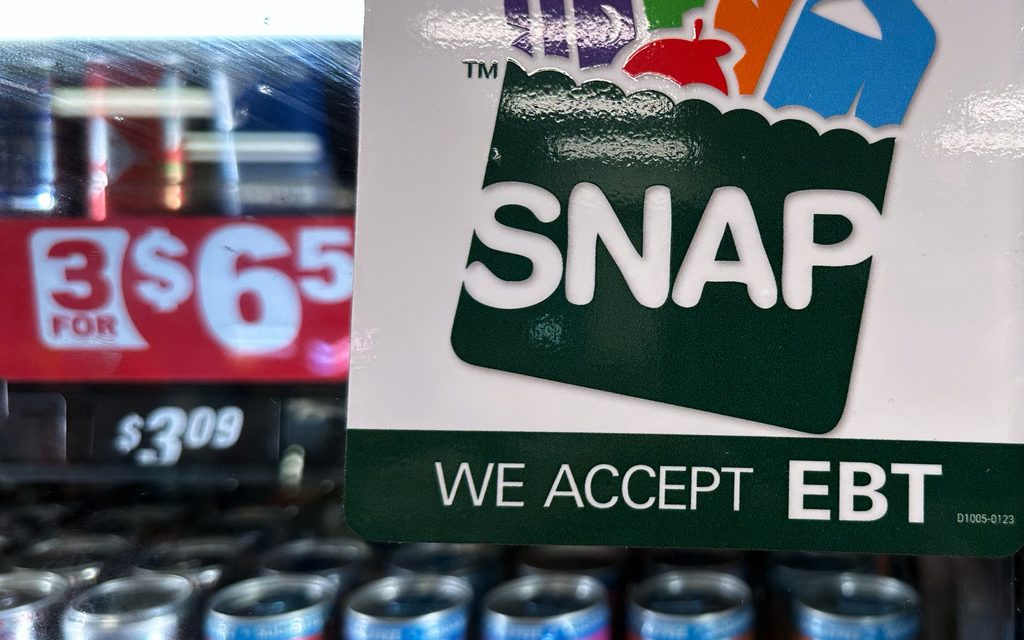
A sign displaying SNAP EBT information is seen at a gas station in Riverwoods, Illinois on November 1, 2025. Recent developments have drawn attention to the handling of food stamp programs across various states.
Niki Kozlowski, director of the Income Support Division at New Mexico’s Health Care Authority, has highlighted the state’s approach to issues of waste, fraud, and abuse in the food stamp program. Despite evident challenges, there is a lack of immediate action to address these concerns.
Federal Reforms and State Reactions
The introduction of the One Big Beautiful Bill Act aims to reform how states manage food stamp expenditures. Under this new reform, starting October 2028, states with significant misspending will be financially accountable for up to 15% of benefit costs, depending on their error rates. This change serves to motivate states to reduce waste and fraud.
However, a loophole allows states to avoid these penalties if their misspending surpasses 13.34%. This means if the error rate exceeds this threshold, states have additional time to rectify the situation. This provision was added by Sen. Lisa Murkowski due to her state’s high error rate, which was 60.4% in 2023.
Current Error Rates Across States
New Mexico’s error rate climbed from 14.6% in 2024 to 16.8% in 2025, further excusing it from federal penalties. Actions in New Mexico appear to be deliberately delaying substantial efforts to combat waste and fraud.
Other states like Alaska, Georgia, Oregon, and Washington, D.C. retain high error rates, showing minimal or negative progress. Delaware and Illinois experienced significant increases in error rates as well, with Illinois rising from 12.3% to 16% and Delaware from 11.5% to 14.6% between 2024 and 2025.
States Exhibiting Improvement
Conversely, states such as New Jersey have shown strides in reducing spending errors, dropping from 14.3% to 6.8%. New York, Maryland, Massachusetts, and Florida have also decreased their error rates below the loophole level. New York and Maryland now report error rates of 13.18% and 13.08% respectively, indicating potential for further improvement.
Legislative Actions and Delay of Penalties
Despite improvements by some, many states are advocating for a delay or elimination of penalties, as seen in the Senate’s draft of the farm bill which proposes a one-year delay. There is a belief that penalties might not materialize, leading to stagnation in efforts to reduce errors.
Hayden Dublois, data and analytics director at the Foundation for Government Accountability, argues that states must be held accountable for misuse of taxpayer funds. He stresses the importance of closing loopholes and enforcing financial accountability.
 U.S. States Extend Gas Tax Waivers Amid Rising Fuel Costs Due to Iran Conflict
  USCIS Raises Immigration Fees
  The Surveillance Threat to U.S. Federal Agents
  Trump Administration Distributes ACA Refund Checks
  Trump Administration’s Approach to Illegal Alien Deportations
  New Jersey Voter Fraud Prompts Renewed Push for SAVE Act