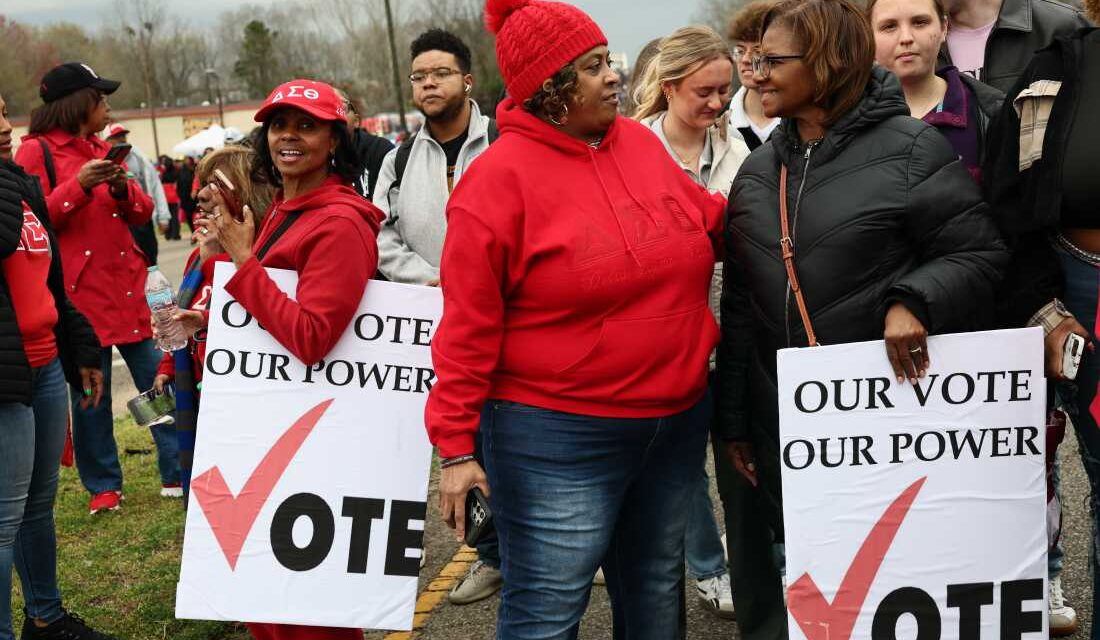
In 2025, members of the Delta Sigma Theta sorority and other participants gathered in Selma, Alabama, to commemorate the 60th anniversary of Bloody Sunday, an event that significantly influenced the passage of the Voting Rights Act. Meanwhile, Republican-led states in the South are revising their congressional maps following a U.S. Supreme Court decision that weakens the Act’s protections against racial discrimination. This ruling could have significant implications at the local level.
Many states and local entities are embroiled in legal battles over at least 17 voting maps, according to a review of federal court records by NPR. These disputes arise from the court’s decision in Louisiana v. Callais, which reinterprets the Voting Rights Act’s Section 2 concerning redistricting. Section 2 now centers on intentional racial discrimination, a standard difficult to prove legally. Critics argue this change threatens the representation of racial minorities and encourages partisan gerrymandering.
Following this decision, some lawsuits have ended. For instance, North Carolina state Rep. Rodney Pierce and another Black voter dropped their lawsuit challenging the state’s Senate map. Pierce expressed concern that the Voting Rights Act now lacks sufficient power to protect Black citizens’ voting rights in his state, lamenting the impact on democracy.
The trend of legal battles primarily arises from the South, where voting is sharply divided between a white majority and a Black minority. However, cases outside the South continue, such as Latino voters’ lawsuits in Washington and Pennsylvania and Native American voters’ challenges in North Dakota.
“Because of that decision, there is no longer a path open to us to protect the voting rights of Black citizens in my part of the State so we have dismissed the suit,” Pierce added.
The Supreme Court’s limits on the Voting Rights Act come as a consequence of a prior ruling that excluded partisan gerrymandering from federal court review. This has led to concerns that local bodies will draw districts that favor political interests over minority representation. Michael Li of the Brennan Center for Justice suggests this could allow white majorities to maintain political control.
Another issue arises from challengers needing to prove racial discrimination separately from partisan preference, which is complicated by the lack of partisan data at local levels. Gilda Daniels, a law professor and former Justice Department official, notes this adds to the complexity.
The Trump administration’s stance has shifted away from reinforcing minority voting rights, with the Justice Department dropping numerous cases, including a challenge in Georgia. This change, combined with the court’s ruling, may lead local governments to undo compliance with Section 2 of the Voting Rights Act.
Experts like Maureen Edobor warn that at-large voting systems could diminish minority representation, allowing majority populations to win all seats in polarized communities, rendering minority votes ineffective.
Local areas such as Fayette County, Tennessee, exemplify ongoing challenges. The county adjusted its voting map to include majority-Black districts, but local NAACP president Elton Holmes remains wary of potential rollbacks if elections do not favor current officials.
Voting rights groups estimate that nearly 200 Democratic-held legislative seats, mostly in majority-Black districts in the South, are at risk due to these changes, indicating potential future obstacles in maintaining fair representation.
 The Surveillance Threat to U.S. Federal Agents
  Trump Administration Distributes ACA Refund Checks
  Trump Administration’s Approach to Illegal Alien Deportations
  New Jersey Voter Fraud Prompts Renewed Push for SAVE Act
  Concerns Over Changes to Voter-Registration Form for Americans Abroad
  Trump’s 2024 Campaign Targets Young Men Through Cryptocurrency