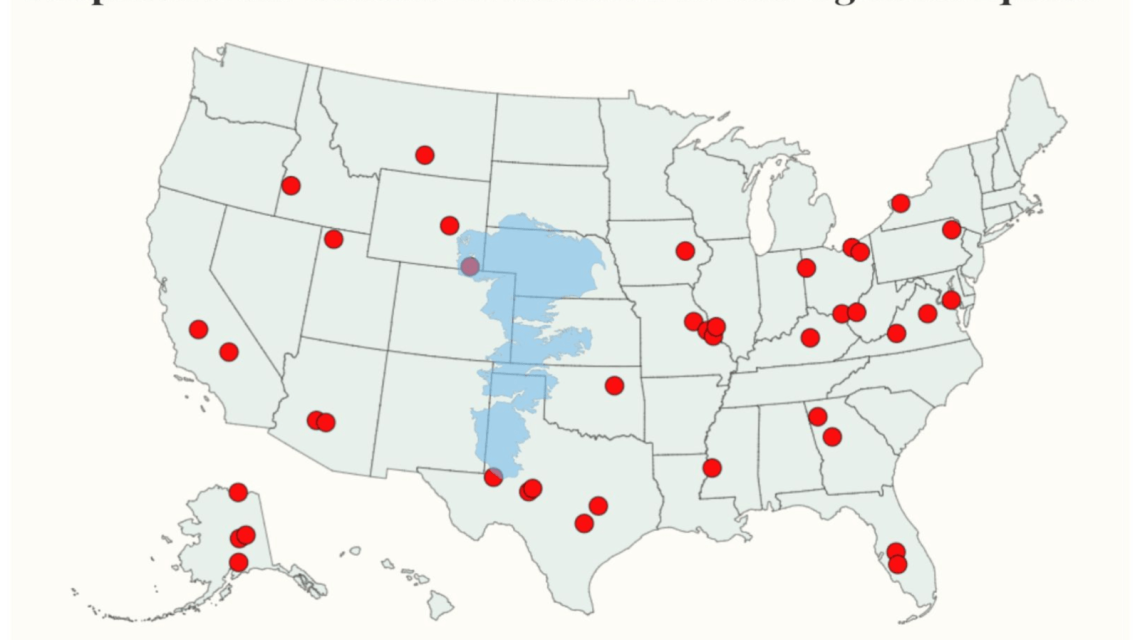
The rapid expansion of AI data centers is raising significant environmental concerns across the Great Plains. Central to this is the question of whether America’s essential groundwater reserves can sustain both a burgeoning digital economy and the agricultural communities reliant on them.
Location of AI Facilities
New mapping by Brockovich AI Data Center Reporting reveals that many planned and active AI facilities are positioned directly above, or close to, the Ogallala Aquifer. This aquifer is crucial for America’s agricultural production.
Local governments in states like Texas and Wyoming are increasingly tasked with weighing the economic benefits of AI investments against long-term concerns about water availability. For example, Charlie Hamilton, Chief Site Development Officer for the Fermi Project Matador in Texas, testified on water conservation before the Texas legislative body on June 24, 2026.
Local Opposition
In Texas, particularly in Tom Green County, local officials have already faced significant public opposition to data center developments. In June 2026, commissioners voted against imposing a 12-month moratorium in Precinct 4 following a massive protest in April, opposing Beacon’s Dove Creek project. Residents have urged stricter state-level water usage regulations for data centers.
Focus on Texas and Wyoming
Several AI projects are drawing attention due to their proximity to the Ogallala Aquifer. In Ector County, Texas, developers are planning to construct a 438-acre campus in partnership with New Era Energy & Digital. Full construction is slated for later in 2026. Similarly, Microsoft plans substantial expansions in Cheyenne, Wyoming, with investments reaching $68 million.
Other projects near the aquifer include:
- The Prometheus Hyperscale in Wyoming, targeting a 2028 operational date.
- Skybox in San Angelo, Texas, planning a large campus on city-owned land.
- Beacon Data Center Dove Creek, Texas, awaiting study results before proceeding.
Construction Developments
A number of data centers over the Ogallala Aquifer are under construction:
- Crusoe Project Jade in Wyoming, expected completion by 2027.
- Related Digital Cheyenne, with phase one concluding by late 2026.
- Fermi Project Matador in Amarillo, Texas, experienced construction delays and leadership changes.
- Aligned Project Caprock in Texas, with the first building operational early 2027.
Different Cooling Technologies
AI data centers employ varying cooling technologies. Related Digital’s Cheyenne campus favors air-cooled systems, minimizing water use. Other projects may employ liquid cooling, impacting water consumption based on system type—closed-loop, dry-cooling, or traditional evaporative towers. Not all projects have disclosed their cooling configurations or water usage plans, complicating assessments of long-term impacts.
The Importance of the Ogallala Aquifer
The aquifer spans eight states—South Dakota, Nebraska, Wyoming, Colorado, Kansas, Oklahoma, New Mexico, and Texas—and is pivotal for North America. It provides roughly 30% of U.S. groundwater irrigation, supporting about one-fifth of agriculture. Decades of use have lowered water levels in many areas.
Sudeep Pasricha, professor at Colorado State University, highlights that some regions have lost water levels at depletion rates exceeding 100,000 acre-feet annually. Scientists warn the aquifer is being mined faster than it recharges, potentially taking centuries or longer to replenish.
Why AI Developers Target the Great Plains
Texas and Wyoming remain attractive for AI infrastructure due to cheap land, power infrastructure, tax incentives, and fewer regulations compared to coastal areas. Benjamin Lee, professor at the University of Pennsylvania, notes that site selection factors include energy, water, land availability, and networking.
Cooling design greatly affects environmental impact, with growing concerns over water consumption influencing evaluations of proposed projects.
Water Consumption by Data Centers
Water use varies significantly among facilities, depending on size, computing density, and cooling technology. Some campuses use modest amounts of water; others exceed the daily needs of small towns. Nationally, U.S. data centers consumed about 17 billion gallons of water in 2023, primarily for cooling.
Analysts predict water consumption will increase significantly as AI infrastructure grows.
Cooling Technology Debate
The discussion around the Ogallala Aquifer focuses on cooling technology choices. Facilities often use evaporative cooling, losing up to 85% of water through evaporation. Alternatives such as air cooling, dry cooling, and closed-loop systems can save water but may require more energy or higher initial costs.
The choice of cooling technology is especially relevant for projects in Texas and Wyoming, but exact configurations are not fully disclosed.
Indirect Water Footprints
Even projects minimizing direct water use can have substantial indirect water footprints due to electricity generation. Research suggests a significant share of water demand occurs off-site, particularly when reliant on water-intensive cooling systems.
AI and Rising Water Demand
AI computing workloads are increasing infrastructure demand at an unprecedented rate. A study led by Shaolei Ren from UCR highlights the water footprint of AI queries. While individual usage seems small, cumulative demand across billions of interactions is substantial.
Sudeep Pasricha underscores that cumulative development poses greater risks than single facilities.
Local Community Responses
Water scarcity is evolving into a political concern. Across parts of Texas and Wyoming, farmers, officials, and residents demand clarity on water sourcing, cooling technologies, and sustainability plans.
Concerns focus on how much water facilities will use and potential risks if supplies tighten, highlighting tensions between economic growth and resource security.
Future Implications
Decisions by developers, regulators, utilities, and governments will shape the future:
- Potential permanent reduction in irrigation capacity.
- Changes in U.S. crop production and food pricing.
- Long-term depletion of irreplaceable groundwater sources.
Pasricha warns the aquifer may become economically impractical for irrigation, reshaping agriculture and rural economies.
Conclusion
The debate is shifting from how much water data centers use to the technologies employed, their locations, and balancing economic growth with resource conservation. For local officials, the pressing question remains whether AI infrastructure can expand without putting more pressure on an already stressed water source crucial to U.S. agriculture.
 Atlantic Ends September Without a Hurricane for First Time Since 1994
  Bobcat Sightings and Conservation Efforts in Illinois
  2026 El Niño: A Historical Comparison and Future Projections
  U.S. Records Warmest September in History
  Swiss Glaciers Show Effects of Ice Loss Amid Global Warming
  Climate-Resistant Rock Glaciers: Hidden Water Resources