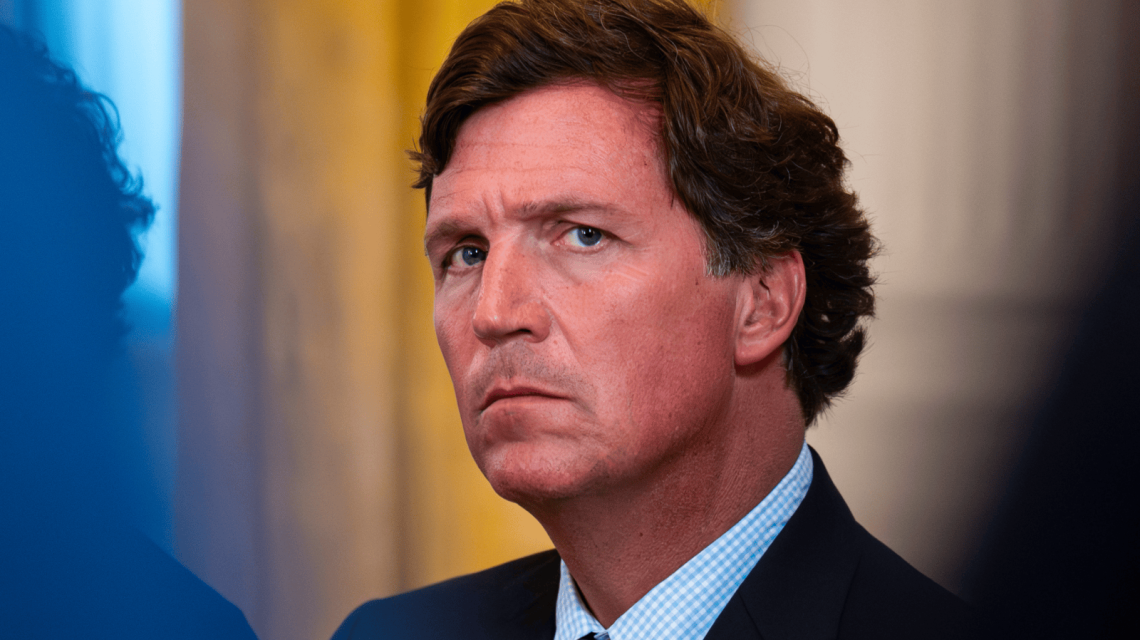
Tucker Carlson has stirred controversy among conservatives after suggesting in a recent interview that Britain’s decision to fight Nazi Germany may not have been the best course of action. In an extensive discussion with former British lawmaker Sir Jacob Rees-Mogg, Carlson questioned whether Britain should anticipate potential conflict with Russia, linking today’s security concerns to historical decisions made during World War II.
Carlson clarified that his remarks were not an endorsement of Adolf Hitler, stating, “I’m certainly not here defending Hitler.” Newsweek reached out to Carlson through his network and Rees-Mogg for further comments.
Carlson’s remarks have sparked public criticism from prominent American conservatives, as well as raised larger questions about military intervention, national interests, and the costs associated with war.
The Debate
The discussion began when Rees-Mogg mentioned the difficulty of avoiding innocent casualties during World War II. Carlson responded, “I never understood why fight the Second World War in the first place.” He argued that German expansionism was partly a response to territorial losses from the Treaty of Versailles and questioned the rationale behind Britain’s involvement.
He further contended that the war significantly diminished Britain’s imperial power without yielding tangible benefits for its citizens. Rees-Mogg countered by emphasizing the moral imperative of defeating Nazism, describing it as a battle between good and evil that preserved Britain from tyranny.
Carlson questioned the long-term benefits of the war for British citizens, suggesting that national survival demands a clearer measure of public welfare improvements. Rees-Mogg rejected this view by arguing that the country’s moral standing was preserved.
Conservative Responses
Criticism came swiftly from conservatives who often align with Carlson on other issues. U.S. Ambassador Mike Huckabee denounced the idea that Britain should have allowed a Nazi conquest, reminding people of Hitler’s atrocities. He suggested that Carlson “needs help.” Lance Forman, a Jewish former British MEP, shared similar sentiments.
Texas Senator Ted Cruz firmly stated, “Yes, Tucker, the UK is better off for winning WWII. America is better off for winning WWII.” British commentator Christopher Snowdon highlighted what he saw as inconsistencies in Carlson’s argument, emphasizing that Nazi occupation would erode, not support, national sovereignty.
Meghan McCain, a conservative television personality, criticized the exchange as “one of the all-time dumbest conversations that has ever been filmed.”
Carlson’s Position
Carlson did not advocate Nazi ideology during the interview. He questioned Britain’s choice to join the war based on the premise of preventing German expansion, which he argued was insufficient reason for the sacrifices made. This stance differed from the conservative belief that confronting Nazi aggression was a moral imperative.
Carlson’s argument reflected a noninterventionist perspective, suggesting that governments should demonstrate clear benefits of warfare to their citizens before committing to military action. Rees-Mogg maintained that opposing an expansionist dictator was itself a necessary and justified action.
Detailed Discussion
The wide-ranging conversation also explored Britain’s support for Ukraine. Rees-Mogg asserted that military readiness deters aggression, while Carlson cautioned against a potential nuclear confrontation with Russia.
Their discussions also touched upon the atomic bombings of Hiroshima and Nagasaki, which Rees-Mogg deemed justified. There was some agreement on free speech issues, with Rees-Mogg acknowledging attacks on freedom of expression in Britain and advocating for the right to express controversial views.
 Sen. Cotton Opposes Permanent Daylight Saving Time
  Steve Hilton’s Latino Outreach and Gubernatorial Ambitions
  The Need for Reform in Presidential Nominations
  Controversy Surrounds Performances at Gillette Stadium
  Celebrity Controversies Over Political Activism and Speech
  Trump Pushes for Permanent Daylight Saving Time, Sharing Senator’s Contact Information