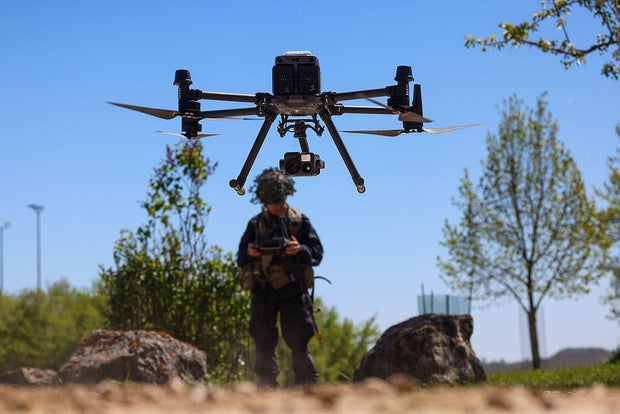
The U.S. Army will discontinue a drone battalion formed to study drone warfare tactics, including those observed in the ongoing Ukraine conflict. This decision was confirmed by an Army official to CBS News, amid internal disputes between senior officers favoring the battalion and Gen. Christopher LaNeve, the acting chief of staff of the Army.
The initiative for the Unmanned Assault Battalion was led by former Army Chief of Staff Gen. Randy George and Gen. Christopher Donahue, the former commander of U.S. Army Europe and Africa. Both officers were either dismissed or retired early, allowing LaNeve to become the acting Army chief of staff. The battalion was designed to be a specialized unit capable of deploying drones anywhere required.
Drone warfare’s significance has been underscored by the Ukraine war and by earlier conflicts in the Middle East, where Iran used attack drones against U.S. military bases. The Unmanned Assault Battalion, part of the 173rd Airborne Brigade, is currently involved in an exercise, concluding in September, to share its insights over the past year with the Army.
An official stated that following the exercise, the battalion will revert to its original role as an airborne infantry unit, trained for parachute operations. The Wall Street Journal initially reported the drone battalion’s disbanding. Last year, an initiative by George and Army Secretary Dan Driscoll emphasized the integration of unmanned systems into the Army.
“I don’t think I’ve talked to a single person who has said we shouldn’t be learning from what’s occurring in Ukraine,” Dan Driscoll expressed on “Face the Nation.”
Tensions between LaNeve and proponents of the drone unit have reportedly been longstanding. An incident involving LaNeve’s early exit as commander of the 82nd Airborne Division and subsequent prompt relocation from his Fort Bragg residence reportedly fueled discord between LaNeve and Donahue.
LaNeve recently released a directive titled “The Army Azimuth,” emphasizing the importance of foundational soldiering skills while integrating defense against unmanned systems. “Every Soldier deserves to know where this Army is headed,” LaNeve stated. “My focus is simple…this Army must fight and win today.”
Retired Army General David Petraeus, also a former CIA director, highlighted the necessity of drones in warfare. During an April conversation with CBS News, Petraeus suggested replacing armored battalions with drone battalions, asserting that the current approach is insufficient.
U.S. Army Capt. Ronan Sefton, engaged in Germany shortly after Russia’s 2022 invasion, shared with CBS’ “60 Minutes” that battlefield observations emphasize the importance of drones. Sefton insisted to senior commanders on the strategic necessity of drones, advocating their integration into training. He later joined the Army’s Ukraine Lessons Learned Task Force, focused on translating Ukrainian military experiences for U.S. forces.
Sefton stressed that, while new technology won’t replace traditional military firepower, the Army must rapidly adapt to counter adversaries’ drone advancements.
 A Cybersecurity Approach to AI Offers Potential Solutions
  Who Should Bear Responsibility for AI Mistakes?
  Urgent Ukrainian Request to SpaceX Over Starshield Restrictions
  Makita Drills: A Comprehensive Buying Guide
  High School Students Explore Surgical Robots
  AI Training in Indian Factories Sparks Workforce Concerns