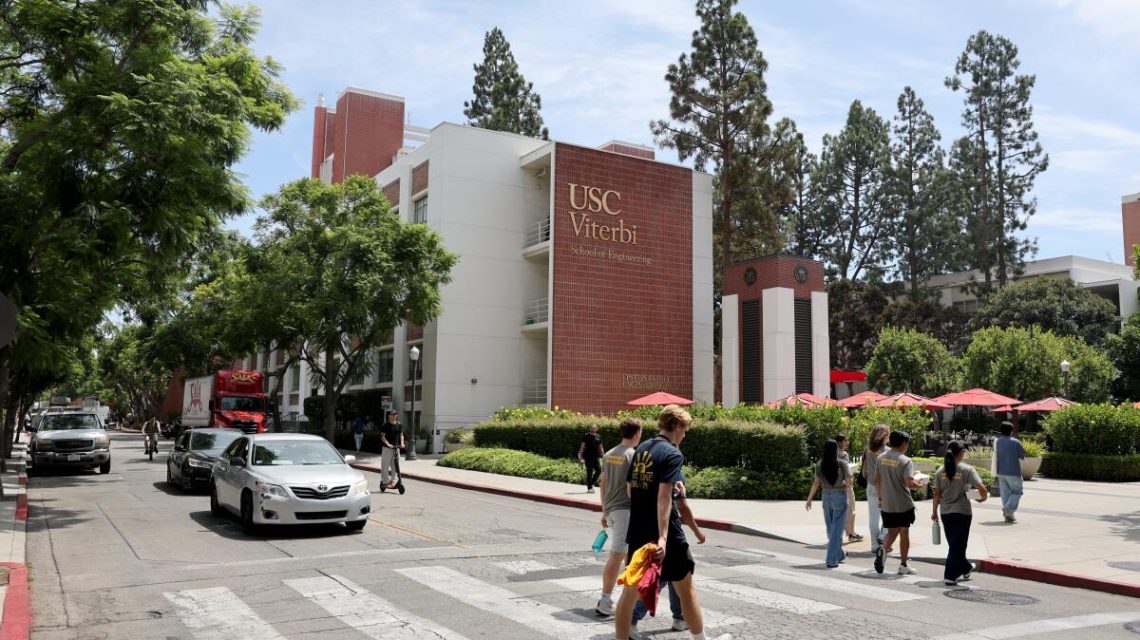
As the new academic year unfolds, USC and UCLA are integrating artificial intelligence (AI) and digital technologies into their curricula. These institutions aim to prepare students for future careers with new AI-centered majors and initiatives. USC’s Viterbi School of Engineering is offering an undergraduate degree in artificial intelligence within the Mark and Mary Stevens School of Computing and Artificial Intelligence. Students will explore AI applications in fields such as drug discovery, robotics, and agriculture over four years. USC emphasizes the importance of ethics courses in the curriculum.
UCLA has established what officials claim is the country’s first Department of Digital Humanities. The new bachelor’s degree focuses on the integration of AI and digital tools into areas like sociology, archaeology, history, and studies of race and gender. These developments are part of a larger effort among universities to adapt to technologies familiar to students from high school interactions, such as chatbot and social media algorithms.
Other universities, including UC Santa Barbara and San Diego State, are also launching AI-focused programs. While some universities like Stanford and UC Berkeley have yet to create similar undergraduate degrees, they offer advanced studies and tracks in AI. The focus at Caltech is on teaching AI fundamentals across disciplines.
Prominent private universities like Carnegie Mellon, MIT, and the University of Pennsylvania offer undergraduate AI degrees. Northwestern will introduce a similar program shortly. However, digital humanities programs are less common, with the University of Pennsylvania offering a minor and research centers at Princeton and Johns Hopkins.
“They’re meeting market demand,” said Michael Horn of the Harvard Graduate School of Education, emphasizing the relevance students and employers seek.
AI majors and digital humanities programs target different student demographics. Engineering programs highlight the broader scope of AI beyond coding, while digital humanities focus on the relationship between liberal arts and technology.
Duncan Deng, a new AI major at USC and a robotics competitor from Beijing, shifted from mechanical engineering to AI after recognizing the significance of algorithms in robotics. Deng’s AI application in strawberry pollination exemplifies the practical impact of such studies. Erik Johnson, Viterbi’s vice dean, noted that ethics is a crucial component of USC’s AI curriculum.
At UCLA, the digital humanities department emerged from a minor program launched in 2011. Alexandra Minna Stern, dean of the Humanities Division, sees the expansion as a response to Los Angeles’s unique convergence of media, tech, and arts industries. The new department aims to produce graduates well-prepared for the evolving job market by understanding AI’s historical and societal implications.
Real-world applications of these studies have benefitted graduates like Cynthia Gong and Kedaar Sridhar. Gong applied her knowledge to improve data accessibility in real estate, while Sridhar leveraged his skills in launching a venture to assist nonprofits using AI. These examples illustrate the practical benefits of blending AI with humanities education.
 Reevaluating Sexual Consent and Gender Dynamics
  Democratic Governors Face Pressure on Federal School Choice Program
  Navigating School Year Challenges and ‘The Talk’ on Safety
  Former Cornell Instructor Discusses Sexual Harassment Allegations
  Cornell University’s Sexual Assault Allegations Spark Legal Battles and Investigations
  Larkin High School Unveils First Outdoor Sports Stadium