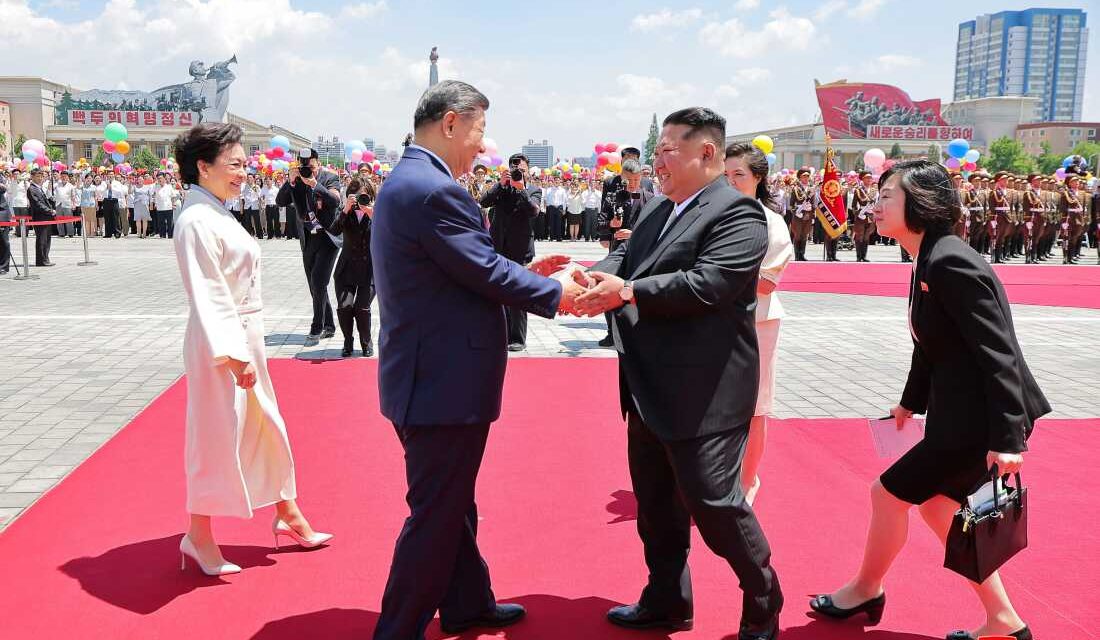
In Pyongyang, Chinese President Xi Jinping and North Korean leader Kim Jong Un reaffirmed their alliance, focusing on strategic cooperation. This meeting occurred during Xi’s first trip to North Korea in nearly seven years. Unlike previous discussions, there was no public emphasis on North Korea’s nuclear weapons program.
Xi’s visit followed a summit with President Trump in Beijing, where both sides reportedly aimed for North Korea’s denuclearization, though Beijing did not publicly confirm this. In Pyongyang, Xi spoke of China’s commitment to shared interests and preserving a strategic environment. Kim emphasized China’s importance, suggesting a diplomatic balance between Beijing and Moscow.
North Korea recently revealed a new nuclear facility and plans to expand its arsenal. The U.S. claims a shared goal of a denuclearized Korean Peninsula with China, but this remains unconfirmed by Beijing. Kim’s sister dismissed these claims as false.
Tong Zhao from the Carnegie Endowment for International Peace noted China’s change in focus. He said China seems to accept a nuclear North Korea to improve bilateral relations, though this could strain U.S. ties with allies like South Korea and Japan.
Previously, China and Russia supported denuclearization. They advocated a “dual track” approach, combining denuclearization with a permanent peace regime. However, geopolitical changes, including Russia’s invasion of Ukraine, have shifted priorities. North Korea supplied munitions to Moscow, while the U.S., Japan, and South Korea strengthened cooperation.
Choo Jaewoo from Kyung Hee University suggests Xi and Kim aim to expand their alliance beyond the Korean Peninsula. This could involve North Korea in regional conflicts, such as Taiwan. The two leaders agreed to increase exchanges, including military cooperation.
Though some speculate about a “CRINK” bloc (China, Russia, Iran, North Korea), Harvard’s Seong-hyon Lee describes the arrangement as transactional. The U.S. and South Korea are also discussing alliance updates, with South Korea potentially leading efforts against North Korea while U.S. forces focus on China.
 British Police Arrest Man Suspected of Terror Plot
  Activists Push for Nationwide Ban on Child Marriage in the U.S.
  Investigation into Alleged Incident at Cornell University
  Rising Drone Threats Highlight Vulnerabilities in Moldova’s Airspace Defense
  Bolivia Faces Security Test Amid Unrest
  Incident on FlyDubai Flight Raises Security Concerns