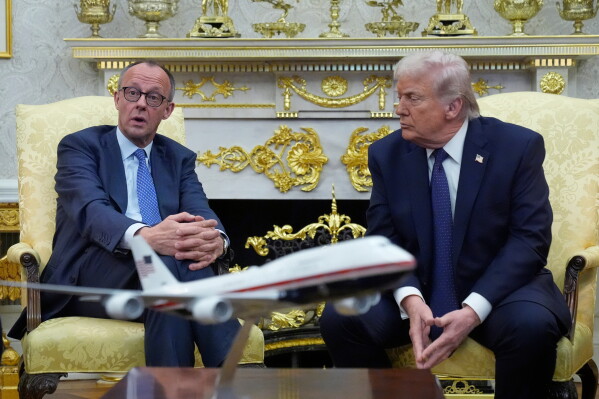
The U.S. military awaits guidance from the Pentagon after President Donald Trump’s fluctuating decisions on troop allocations in Europe. This unpredictability affects military personnel and could incur significant costs, according to two U.S. defense officials speaking to The Associated Press.
NATO Partners Uncertain
In May, Trump’s announcement to send 5,000 U.S. troops to Poland surprised NATO allies. This decision came shortly after ordering the same number of troops’ withdrawal from Europe, amidst tensions with Germany’s Chancellor Friedrich Merz concerning the Iran conflict. The Trump administration claims these troop reductions are part of longstanding plans coordinated with allies.
President Trump recently disclosed on social media his plan to deploy troops to Poland. However, the Pentagon had already ceased a rotation of soldiers headed there, as confirmed by a defense official. Equipment meant for this deployment was already en route, resulting in a cost of $32 million, according to the U.S. Transportation Command.
Policy Adjustments and Military Morale
Consequent to Trump’s unexpected announcements, the military now has to align its policies in accordance with these new orders, stated a defense official. The uncertainty extends beyond allies, affecting morale among American troops experiencing abrupt changes to their deployment plans.
The Army had previously canceled the deployment of 4,000 troops from Fort Hood, Texas, slated for a rotational tour in Poland. European allies were made aware of this cancellation mid-May. As a result, some military personnel were instructed to remain, while others await confirmation to return, highlighting the lack of clarity from the Pentagon.
Financial Implications
The financial burden of returning troops and equipment adds pressure to the Pentagon’s budget, which was not accounted for in initial planning. Joe Costa, a former senior Pentagon official now part of the Atlantic Council, suggests costs are predominantly associated with the return of equipment and personnel.
Military contracts often have cancellation clauses, escalating expenses in such scenarios, said John Deni, an expert on military costs. The extent to which these costs can be recovered remains uncertain, as both the Pentagon and the White House declined to comment.
Strategic Considerations
Trump’s prior threats to pull 5,000 troops from Europe initially targeted the 2nd Cavalry Regiment based in Germany. However, shifting plans have generated further confusion. Removing troops stationed in Germany may incur costs in the low billions due to a lack of U.S.-based infrastructure to support them.
Dispersing troops and their equipment to different regions disrupts unit cohesion and readiness, Costa noted. Deployment cancellations adversely affect the morale of military families, who plan extensively for such assignments.
Budget Challenges
These troop movements are occurring amidst an army budget shortfall, which Gen. Christopher LaNeve acknowledged ranges between $2 billion and $6 billion. Budget constraints have led to reduced training courses nationwide.
The Department of Homeland Security’s expected reimbursements for border deployments remain pending, adding stress to the Army’s finances.
The military in Europe is now minimizing non-combat related training and rigorously prioritizing essential functions in response to these deployments. The shifting landscape continues to pose challenges for U.S. military strategies.
Burrows reported from London.
 Israel and Ireland Soccer Teams Display Tension in Nations League Match
  Fox News Report on FlyDubai In-Flight Incident
  Brazilians Vote in Crucial Presidential Election
  Search Continues for Missing Michigan Woman Lynette Hooker
  Russia Navigates Pressure and Diplomacy Amid Ongoing Conflict in Ukraine
  Tensions Rise Between U.S. Ambassador and South African President