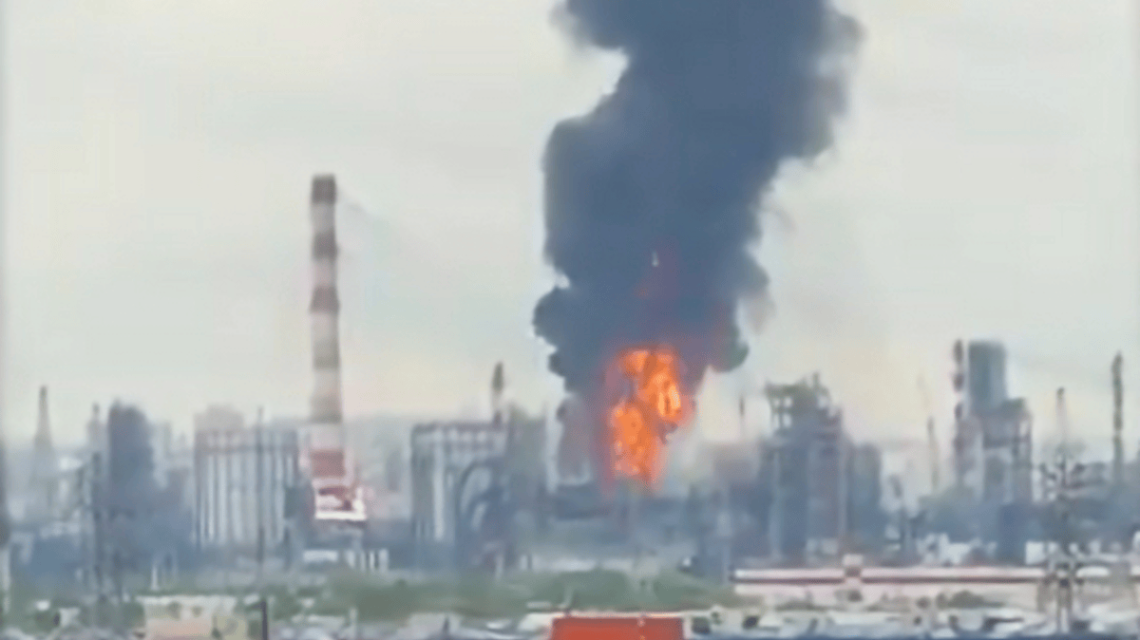
Ukraine launched an attack on a significant oil refinery near Moscow overnight, instigating a large fire and sending dark smoke into the sky over the Russian capital. This marks a recent instance of Ukraine targeting essential oil infrastructure far across its border.
The attack followed a massive Russian aerial strike on Kyiv, Ukraine’s capital, which resulted in damage to a renowned cathedral and monastery. This incident provoked international criticism. Ukrainian officials reported that at least 11 people were killed in Ukraine.
The world’s leading economies plan to convene at the G7 summit in France this week to discuss a ceasefire deal for the ongoing conflict.
Ukrainian President Volodymyr Zelensky confirmed the operation, stating that drones traveled 500 kilometers (310 miles) to strike the Moscow Oil Refinery. He described this as a “just response” to Russian attacks on Ukraine.
The Moscow Oil Refinery, the largest in the region, supplies around 40 percent of the petroleum demand in the area surrounding the Russian capital, according to Ukrainian media.
Moscow Mayor Sergey Sobyanin reported on social media that Russian air defenses intercepted 60 Ukrainian drones over the capital overnight, with one drone damaging an unspecified facility within the refinery. No injuries were reported.
Ukrainian official Andriy Kovalenko stated that a unit used for processing oil was set on fire. Reports from Russia’s Tass state news agency indicated this was among the largest drone strikes by Ukraine on the Russian capital this year.
Zelensky expressed, “This time, the Moscow region felt the reach of Ukraine’s long-range capabilities.” Kovalenko noted concerns over whether the refinery would be suspended or suffer significant capacity loss.
Kyiv has consistently targeted Russia’s oil refineries, pipelines, and storage facilities with drones that can cover extended distances. This strategy aims to disrupt essential funding for Russia’s war efforts.
Russia, as a major oil exporter, has seen its crude oil production drop by hundreds of thousands of barrels per day. The Iran war and Gulf chaos have simultaneously increased demand for Russian oil.
Earlier this month, Russia’s energy ministry acknowledged “temporary difficulties with fuel supplies” in southern Russia due to Ukrainian airstrikes. A new task force has been established to address these supply issues.
Ukraine’s SBU internal security service reported involvement of its drone forces, special operations forces, and military intelligence operatives in the attack, as confirmed by Zelensky.
 British Police Arrest Man Suspected of Terror Plot
  Activists Push for Nationwide Ban on Child Marriage in the U.S.
  Investigation into Alleged Incident at Cornell University
  Rising Drone Threats Highlight Vulnerabilities in Moldova’s Airspace Defense
  Bolivia Faces Security Test Amid Unrest
  Incident on FlyDubai Flight Raises Security Concerns