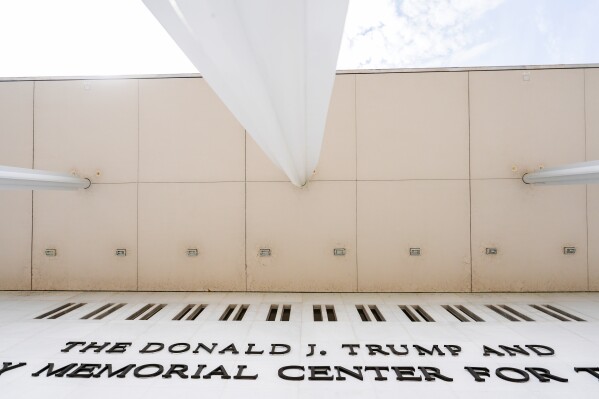
A federal judge has ruled that President Donald Trump’s addition of his name to the Kennedy Center is illegal and blocked the administration from proceeding with planned major renovations. This is a recent legal setback for Trump’s ongoing attempts to make his mark on prominent sites in Washington, D.C. Following this ruling, Trump announced his decision to abandon the renovation plans and return control of the arts venue to Congress.
U.S. District Judge Christopher Cooper, based in Washington, D.C., criticized the Kennedy Center board’s decision made on March 16 to close the venue, describing it as lacking proper consideration of legal requirements. The renovation, originally planned to start in July and last two years, is now on hold. Cooper also pointed out that the board exceeded its authority by adding Trump’s name to the center, stating that Congress alone has the power to rename the Kennedy Center.
Judge Cooper, appointed by President Barack Obama, has ordered the removal of Trump’s name from the building’s front and any related materials within two weeks. Trump reacted to this decision by suggesting that the judge should feel ashamed and instructed his administration to prepare to hand the center back to Congress.
Throughout his second term, Trump has prioritized leaving a personal legacy on historic landmarks in Washington, D.C. He has overseen significant alterations to the East Wing of the White House and added his name or image to several government buildings. Legal opposition has met many of these projects, leading to favorable rulings against them. Despite the lower court rulings, appeals from the administration are likely.
Roma Daravi, the Kennedy Center’s vice president of public relations, voiced confidence in appealing the court’s decision. She emphasized the urgent need for restoration, backed by $257 million approved by Congress for the Kennedy Center’s renovation, also asserting a commitment to fixing the cultural landmark legally.
The ruling comes after hearings in April addressing two lawsuits against the project. One was initiated by cultural preservation groups, and the other by Rep. Joyce Beatty, an ex officio member of the Kennedy Center board. Cooper ruled in favor of Beatty but dismissed the challenge from the preservation entities.
Rep. Beatty hailed the decision as a victory for the Kennedy Center and the performing arts. Her concerns were rooted in avoiding unsupervised changes similar to those Trump implemented at the White House.
Mike Floca, the Kennedy Center’s executive director, has detailed the building’s pressing needs for repairs. The center’s infrastructure, including aged equipment, displays serious damage. Tours conducted for lawmakers, journalists, and officials were designed to highlight these issues and stress the necessity for action.
While performances continue at the Kennedy Center, the schedule is less active than in previous years. Notable events are planned, including Bill Maher receiving the Mark Twain Prize for American Humor, anticipated as one of the last notable occurrences before the proposed closure.
 Sen. Cotton Opposes Permanent Daylight Saving Time
  Steve Hilton’s Latino Outreach and Gubernatorial Ambitions
  The Need for Reform in Presidential Nominations
  Controversy Surrounds Performances at Gillette Stadium
  Celebrity Controversies Over Political Activism and Speech
  Trump Pushes for Permanent Daylight Saving Time, Sharing Senator’s Contact Information