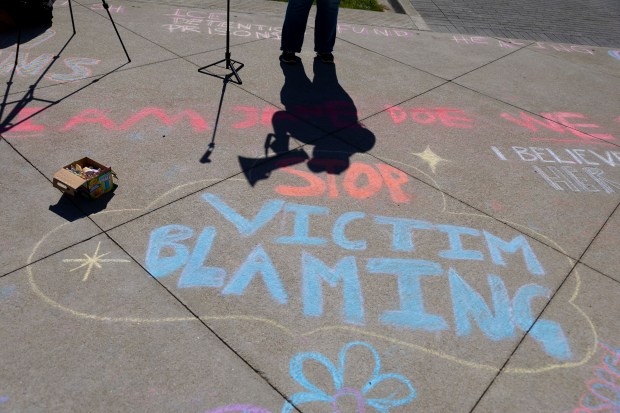
By noon on Thursday, the University of Illinois Chicago’s quad became a hub of activism. Around thirty students gathered, armed with protest signs and flyers denouncing sexual violence. The sidewalk outside Lecture Center Building B was adorned with vibrant chalk murals bearing messages like “We are Jane Doe” and “Stop Victim Blaming.”
These protests are part of a broader movement across various campuses in Chicago and Illinois, spurred by the resurfacing of a sexual violence case at Cornell University. Last month, a woman referred to as “Jane Doe” initiated a civil suit after prosecutors chose not to file criminal charges against seven men she accused of raping her at a fraternity party in Ithaca, New York, in 2024. Renewed investigations and the appointment of a special prosecutor at Cornell have put the spotlight on how the case was handled, stirring national headlines and conversations about campus sexual violence.
The repercussions have driven schools nationwide to amplify advocacy efforts, improve resources, and offer support to students and sexual assault victims. Illinois students have seized this momentum to spotlight the prevalence of sexual assault and the response of authorities.
Thursday witnessed a “National Day of Action” where hundreds of students at Lincoln Park High School walked out of class in support of ongoing “Stop Sexual Violence” protests at UIC and Southern Illinois University Edwardsville. At UIC, student speakers addressed the crowd from a megaphone, emphasizing accountability and justice for the Cornell incident.
The first to speak was Nova Mohiuddin, a 23-year-old economics major and organizer with UIC’s chapter of Chicago Socialist Alternative. Mohiuddin stressed the importance of challenging sexism and the normalization of misogynistic attitudes.
Additionally, male students like Jacob Belencion stressed the necessity of male participation in these advocacy spaces, urging peers to call out misogynistic behavior. Meanwhile, students at SIUE joined the action. Isabel Montano, a junior, decided to mobilize at SIUE after learning about the Day of Action online. Montano emphasized that channeling emotions into activism can lead to positive change. She noted that raising awareness about sexual violence issues could contribute to wider transformation.
Protests also extended beyond college campuses. Lincoln Park High School students marched out while chanting against sexual violence and with banners reading “#EndSexualViolence.” Student Isabella Scaffai, experienced in organizing protests, helped plan this demonstration through the Women Empowerment Club at LPHS. She expressed disillusionment over the ongoing threat of sexual violence, highlighting its impact on college-bound students.
Furthermore, senior Chloe Woodall contributed by creating posters and raising awareness online. The demonstration provided an educational opportunity, stressing the importance of understanding consent and the nuances of sexual assault.
Chicago campuses offer support resources like Northwestern University’s Center for Student Advocacy and Wellness and UIC’s Women’s Leadership and Resource Center. Sarah Layden of Resilience, a nonprofit organization, suggests utilizing such resources, including the 24-hour Chicago Rape Crisis Hotline. She emphasizes diverse responses among survivors, advocating for education and safe spaces for healing across all ages.
 The David Network and Conservative College Initiatives
  Police and Media Response to Shooting at Richneck Elementary School
  Documentary Reveals Impact of School Closures After COVID-19
  Florida’s Educational Choice Scholarships Transform School Options
  Cornell University Allegations Spark Nationwide Protests
  Record Book Bans in U.S. Schools Amid Debate