Chicago Public Schools (CPS) officials have expressed urgency in passing the district’s $9.88 billion budget this month, warning that failure to do so could jeopardize payroll for 45,000 employees. If the budget doesn’t receive approval, payroll disruption is imminent for September. CPS CEO Macquline King emphasized the impact on student services during an interview with the Tribune.
The Board of Education is scheduled to vote on the 2026-27 budget on July 30, a month ahead of the state-mandated deadline. Recently, the district announced the layoff of over 700 teachers as part of its spending strategy. Without additional funding from the city or state, CPS plans to initiate a spending freeze from January and convert five professional development days into furloughs.
Despite opposition from the Chicago Teachers Union (CTU), which advocated against the budget proposal at the recent hearing, CPS leaders insisted that postponement of the vote is not an option. The district requires an approved budget to secure short-term borrowing via tax anticipation notes (TANs), a crucial component for managing cash flow between property tax payments, especially given current delays from Cook County.
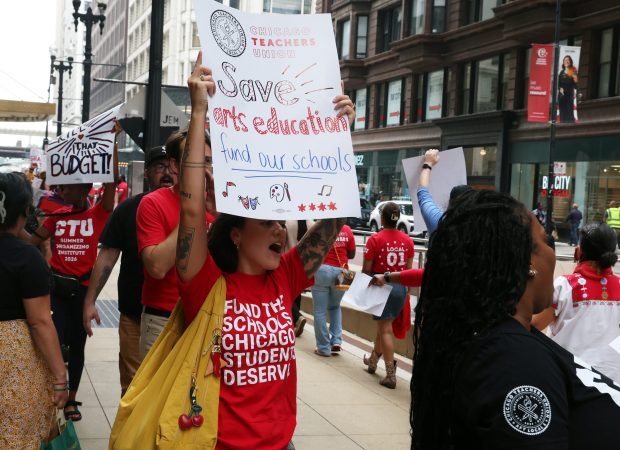
CTU and its allies held protests outside CPS headquarters on July 20, 2026, coinciding with the Board of Education’s meeting on the 2027 budget.
Several board members called for CPS leaders to formulate a solid strategy to increase state or external funding. The state’s Evidence-Based Funding formula provides only 73% of the district’s adequacy target. CTU-aligned board members have urged state lawmakers to convene a special session for additional funding.
Board member Jitu Brown, representing District 5A, expressed concerns about the perceived inequity in the proposal despite assurances of minimal classroom impact. Feedback from elementary and high schools suggests otherwise, prompting public comments from teachers and staff in CTU shirts, calling to reverse the cuts.
Debby Pope, representing District 2B, questioned the disparity between claims of a student-centered budget and reported cuts, particularly in special education.
District leaders, however, consider the cuts a necessity to address the district’s $732 million deficit. Furlough days are deemed a last resort aimed at non-instructional days to minimize disruption to students. Each furlough day would save $17 million, equating to roughly a 2% pay cut for teachers, effectively reducing their contractual raises.
CPS is actively seeking other revenue streams, including potential funds from tax increment financing districts and participating in Cook County’s interest-free loan program, which would alleviate costs associated with delayed property tax payments. Last year, CPS paid $43 million in interest on short-term loans.
King believes that participation in this loan program warrants discussion, potentially redirecting millions to classrooms and reducing the need for furloughs. The district has faced financial challenges for years, dealing with rising costs, aging infrastructure, and substantial long-term debt exceeding $9 billion.
CTU staged a rally prior to the budget meeting, advocating against cuts and furloughs, highlighting the negative impact on Chicago’s students, educators, and school communities.
 David Madigan Appointed as USC’s Chief Academic Officer
  North American Values Institute Questions Pittsburgh Schools’ New Curriculum
  Debate Over Proposed English-Only Rule for Head Start Programs
  Impact of Removing Regents Requirement on Education
  Impact of College Rankings on Lesser-Known Institutions
  Evaluating Accountability in Missouri’s Education System