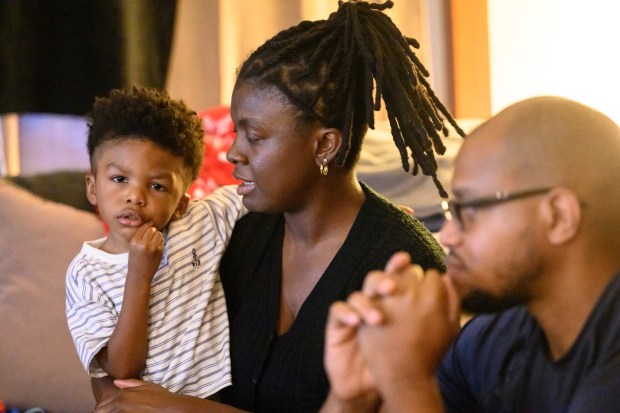
As three-year-old Eliazer Glover played in the family living room in Hammond, he tumbled and hurt his elbow. His mother, Kal Glover, comforted him with a kiss, soothing his injury. Yet, Eliazer’s battle with sickle cell disease is more complex. Kal and her husband, Samuel, refuse to let the condition define their son.
“I don’t want the stigma to linger,” said Kal Glover. She and Samuel discovered Eliazer had sickle cell during his initial pediatric appointment, shortly after his birth. They had anticipated the possibility of a trait, not the disease itself.
Sickle cell disease affects the hemoglobin in red blood cells, causing a crescent shape that obstructs blood flow. Eliazer has Hemoglobin SC, a milder form. The condition arises from familial traits Kal and Samuel weren’t aware of until the diagnosis. “We were confused,” Kal shared.
Samuel was somewhat familiar with the disease, as a cousin’s daughter also has it. Despite this, Eliazer’s diagnosis stunned him. “It was disbelief,” he said.
Pediatric hematologist Dr. Laura Tyrrell noted the disease’s prevalence in people with ancestry from regions where malaria was or remains common. This includes Africa, parts of Latin America, South Asia, the Middle East, and the Mediterranean. Tyrrell explained that while sickle cell disease is seen across all ethnic groups, it more frequently affects African Americans.
Tyrrell highlighted that pain crises from blocked blood flow are the primary reason for emergency room visits among sickle cell patients. A body temperature exceeding 101 degrees can signal an infection, posing risks if in extreme weather.
Monitoring Eliazer’s health is a priority. The Glovers ensure he stays cool during sleep since Eliazer often feels hot. “It’s not difficult,” Kal noted. Eliazer undergoes extra vaccinations and takes liquid penicillin daily until he reaches five.
Awareness of his condition is still developing for Eliazer. However, he regularly takes his medicine eagerly, sometimes reminding Kal and Samuel about it. “He likes his medicine,” Kal mentioned with surprise.
Statistics from Dr. Tyrrell indicated that in Indiana, 1,049 babies were born with the sickle cell trait, and 31 with the disease. Around 1,800 residents live with it, with Lake and Marion counties recording the highest numbers.
Initially, the Glovers traveled to Indianapolis for Eliazer’s checkups due to limited local resources. They now use a clinic in Gary, which has made their journey easier. The clinic provides resources and community connections.
Despite the challenges, the Glovers are optimistic. They don’t allow sickle cell disease to overshadow Eliazer’s growth or happiness. “He’s special,” Kal commented. Samuel added, “You would think he was a normal child until we tell you that he has sickle cell disease.”
 Understanding Inflammation: Myths and Facts
  Calm Parenting: Strategies to Manage Stress
  Trump’s Executive Order to Combat Mosquitoes and Ticks in D.C.
  Overcoming Weight Loss Challenges: Brain Health and GLP-1 Medications
  Supporting Children’s Mental Health at Home: Practical Steps for Parents
  Abdul El-Sayed’s Strategy to Attract Health-Conscious Voters in Michigan