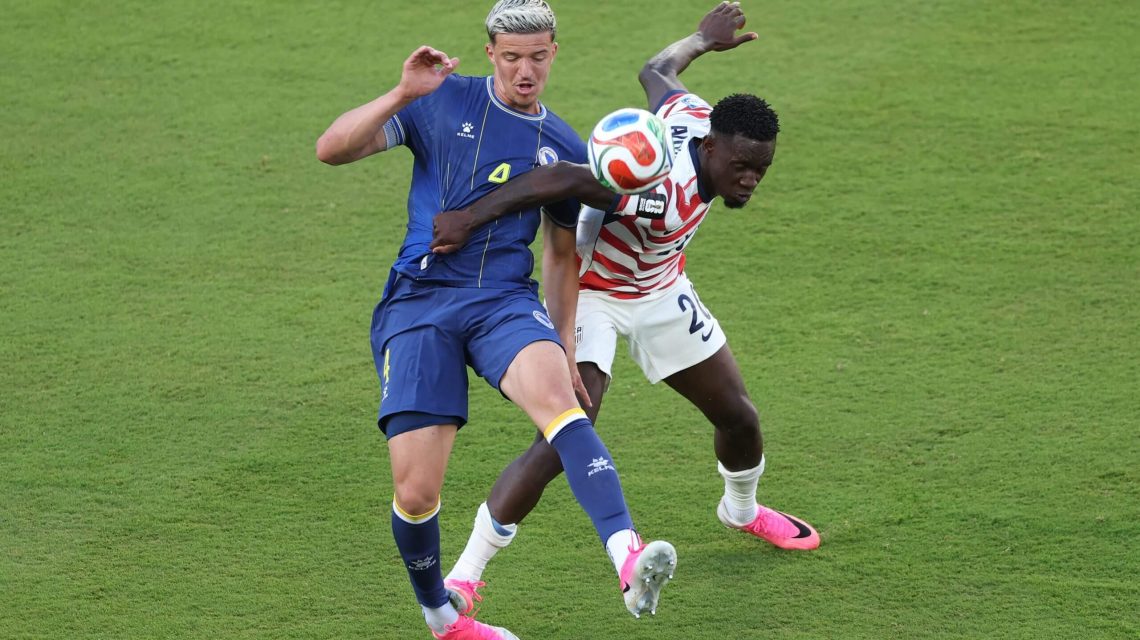
During the round-of-32 game against Bosnia and Herzegovina, Folarin Balogun received a red card in a significant moment for the United States. Balogun, aged 24, fouled Tarik Muharemovic in the second half on Wednesday night in Santa Clara. The referee, Raphael Claus, decided to show Balogun a direct red card, prompting visible distress from the player. Balogun’s teammates provided comfort as he exited the field.
Despite his absence, the United States overcame the setback. They maintained the 1-0 lead set by Balogun earlier and secured a win with Malik Tillman’s late free kick. This victory ensured their place in the last 16, where they will compete against Belgium in Seattle on Monday, July 6. Unfortunately, Balogun will not participate due to his suspension.
Details of the Incident
As Antonee Robinson played the ball up the left sideline in the 61st minute, Balogun attempted to position his body correctly. In doing so, he inadvertently landed on Muharemovic’s leg, causing contact that appeared rough. While it seemed unintentional in real-time, slow-motion replay showed a forceful action. There was no doubt regarding the strong impact on the defender.
The Video Assistant Referee (VAR) instructed Claus to review the event. After assessment, Claus confirmed Balogun had committed a “serious foul” necessitating his dismissal from the game.
Understanding the Red Card Decision
Announcing his decision to the stadium, referee Raphael Claus explained that Balogun engaged in a “serious foul.” The International Football Association Board rules clarify that tackles endangering an opponent or involving excessive force are serious foul play. Even if unintended, tackles that compromise opponent safety fall under this category.
FIFA’s 2026 World Cup regulations articulate that a direct red card results in automatic suspension from the subsequent match, potentially extending if necessary. If a suspension cannot occur within the tournament due to the team exiting, it carries over to the next official match, following FIFA’s Disciplinary Code.
Expert Analysis on the Decision
Former Premier League referee Graham Scott offered insight into Balogun’s red card situation. The availability of VAR emphasizes contact point analysis. Historically, fast uncontrolled tackles prompted red cards; however, modern video review can exaggerate actions. Innocuous tackles may appear intense in slow-motion, leading to stringent judgments.
Scott noted the changing trend encapsulates Balogun’s situation. His actions were part of routine football dynamics and not reckless. Despite lack of control, the video evidence painted the tackle as harsher, prompting a red card.
The emphasis on safety through VAR means Balogun’s red card was inevitable, despite the unfortunate nature of the situation. Scott believes that such fouls should merit cautions instead.
Possible Appeals and Future Impact
According to FIFA regulations, teams cannot appeal red cards or related suspensions. Instead, all red cards undergo evaluation by FIFA’s disciplinary committee, possibly resulting in further sanctions. In Balogun’s case, he will miss the USA’s match against Belgium, with potential for additional suspension depending on the committee’s decision.
Previously, Miguel Almiron’s one-match suspension remained unchanged, while Assim Madibo faced an extended ban for a similar tackle causing injury.
Balogun’s Attendance at Future Games
Despite his suspension, Balogun can attend games at Lumen Field with restrictions. He may sit in the stands but must avoid the field, dressing rooms, stadium tunnels, and technical areas during the match.
 Nick Saban’s Comments on ESPN Spark Debate Over College Sports Regulations
  Freddy’s American Adventure: From Soccer to College Football
  Brock Purdy’s Impressive Start in the 2026 NFL Season
  The Value of Retaining Miles McBride for the Knicks
  Penguins Make History with Dominant Season Opener
  Sonny Gray Expresses Frustration After Game Against Yankees