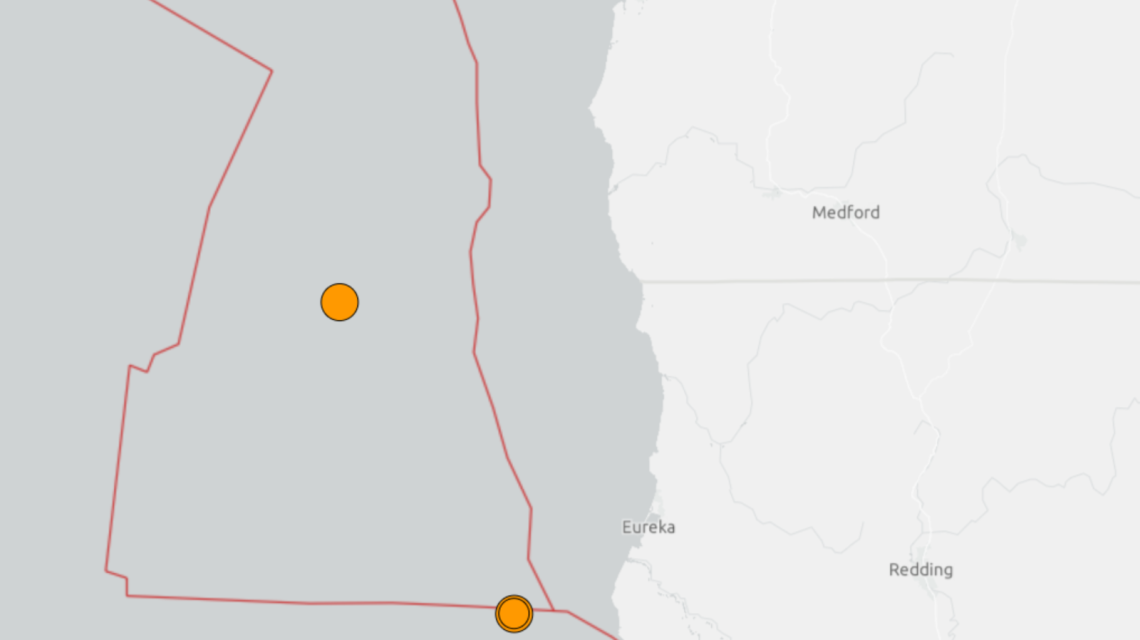
A series of offshore earthquakes, with two reaching magnitude 5.0 or higher, struck in the Pacific Ocean near Northern California early Wednesday. This information comes from the U.S. Geological Survey (USGS). These moderate earthquakes occurred over a few hours near the California–Oregon border. Coastal communities were already on alert after a stronger magnitude 5.7 earthquake hit off the Oregon coast earlier that morning. USGS data reveals few local residents reported feeling the quakes, and no damage has been recorded.
Where Did the Earthquakes Strike?
Initially, the magnitude 5.7 quake hit off the Oregon coast, around 100 miles west-southwest of Pistol River, as per USGS data. Following this, a magnitude 5.1 earthquake occurred about 40 miles, or 64 kilometers, west of Petrolia, California, at a shallow depth of about 0.12 miles (633.6 feet). This quake was followed by tremors measuring 4.5 and 2.8 magnitudes in the same area. Additionally, a minor 1.8 magnitude quake was detected nearby, approximately 11 miles west of Petrolia.
The shallow nature of these earthquakes increased the likelihood of being felt along the coast, although initial reports noted minimal effects. Officials confirmed no tsunami warnings were issued, and there were no immediate reports of significant damage or injuries.
Dozens of Smaller Earthquakes
Recently, numerous smaller earthquakes have occurred throughout California. USGS measured a total of 82 quakes in recent days. In Northern California, at least 35 quakes, ranging from 0.03 to 3.6 magnitudes, were recorded. Most of these were north of Santa Rosa, near Mercuryville, which has seen notable activity lately. Moreover, USGS recorded 47 small quakes, with magnitudes from 0.3 to 2.5, stretching from Parkfield in the north to Imperial in Southern California.
Why Are Earthquakes Common in California?
Earthquakes are frequent in California because the state lies on a major tectonic plate boundary—one of the world’s most active. California is situated along the boundary between the Pacific Plate and the North American Plate. These huge sections of Earth’s crust continually move past each other along faults, such as the San Andreas Fault. This movement isn’t smooth, as friction causes the plates to get stuck. Stress then builds up underground until it’s suddenly released, resulting in an earthquake.
Furthermore, California isn’t limited to one fault. It contains a wide network of faults, including the San Andreas and many smaller ones, which distributes seismic activity across the state. This means earthquakes can occur in multiple regions, not just along a single fault line.
 Los Angeles Faces Uncommon Heatwave in October
  Drought Drives Black Bears Closer to Human Activity
  Atlantic Ends September Without a Hurricane for First Time Since 1994
  Bobcat Sightings and Conservation Efforts in Illinois
 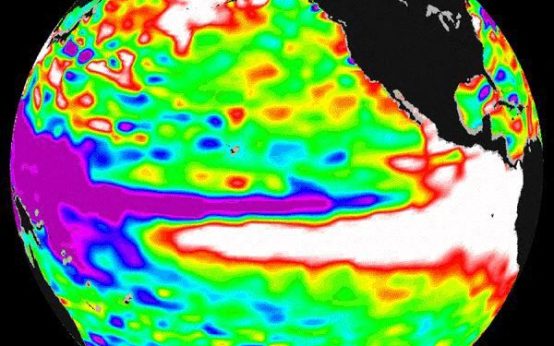 2026 El Niño: A Historical Comparison and Future Projections
  U.S. Records Warmest September in History