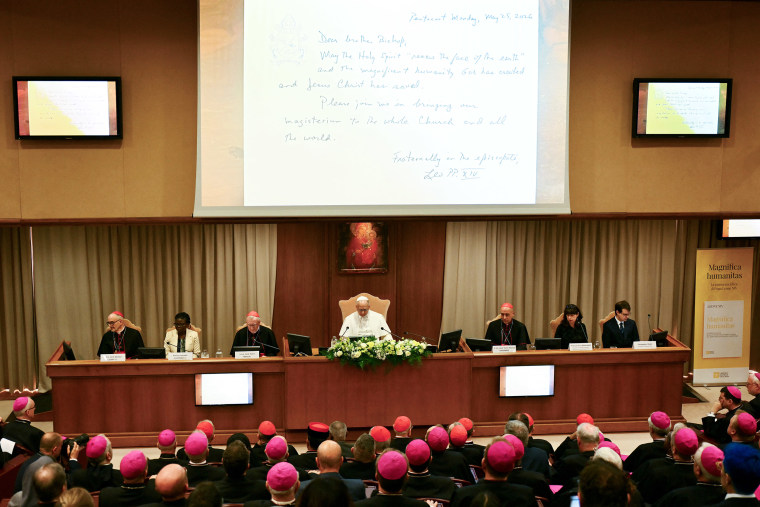
Pope Leo XIV has urged for stronger regulation and a more cautious approach to the development of artificial intelligence (AI). In a significant theological document released on Monday, he expressed concerns that AI is contributing to global conflicts. Leo emphasized that AI should not be controlled by a select few.
In his first encyclical, titled Magnifica Humanitas (Magnificent Humanity), Leo stated that AI should be disarmed,
not to reject technology, but to prevent its dominance over humanity. He emphasized that mere regulation is insufficient.
This document was released at the Vatican with the co-founder of AI company Anthropic, Christopher Olah. This collaboration marks a new tension with President Donald Trump, whose administration has banned Anthropic following the company’s refusal to give the U.S. military unrestricted access to its technology.
Olah, during the Vatican presentation, acknowledged the challenges AI labs face, stressing the need for external critics to influence and direct the use of AI responsibly. He encouraged religious communities, civil society, scholars, and governments to be proactive in guiding AI’s future.
Leo’s encyclical was signed on May 15, marking 135 years since Pope Leo XIII’s document on workers’ rights during the industrial revolution. Unlike his predecessor’s focus, Leo XIV aims to address technological advancements with modern wisdom.
Leo, a pope with a strong background in mathematics, clarified that technology is not inherently opposed to humanity. He warned against the risks of AI being controlled by powerful private interests, potentially leading to wars with unmanned weapons. AI’s morality should not be defined by a select few.
Leo called for caution, thorough evaluation, and, when necessary, a slower adoption pace for AI, viewing this as responsible care for humanity. Vatican analyst Deborah Lubov noted Leo’s enthusiasm for science and technology, coupled with his recognition of AI’s risks, advocating for a moral and ethical framework.
Leo addressed the ease of deploying autonomous weapons systems, which makes war more plausible and less controlled by humans. He argued for strict ethical constraints on using AI in warfare to respect human dignity and prevent the arms race.
The pope cautioned against a violent culture where peace is seen as a temporary state. He expressed that addressing AI’s impact is not just ethical or technical but ecological, as it is both an environment and a force we must engage with. Thus, AI requires more than regulation; it demands being made accessible and welcoming.
 British Police Arrest Man Suspected of Terror Plot
  Activists Push for Nationwide Ban on Child Marriage in the U.S.
  Investigation into Alleged Incident at Cornell University
  Rising Drone Threats Highlight Vulnerabilities in Moldova’s Airspace Defense
  Bolivia Faces Security Test Amid Unrest
  Incident on FlyDubai Flight Raises Security Concerns