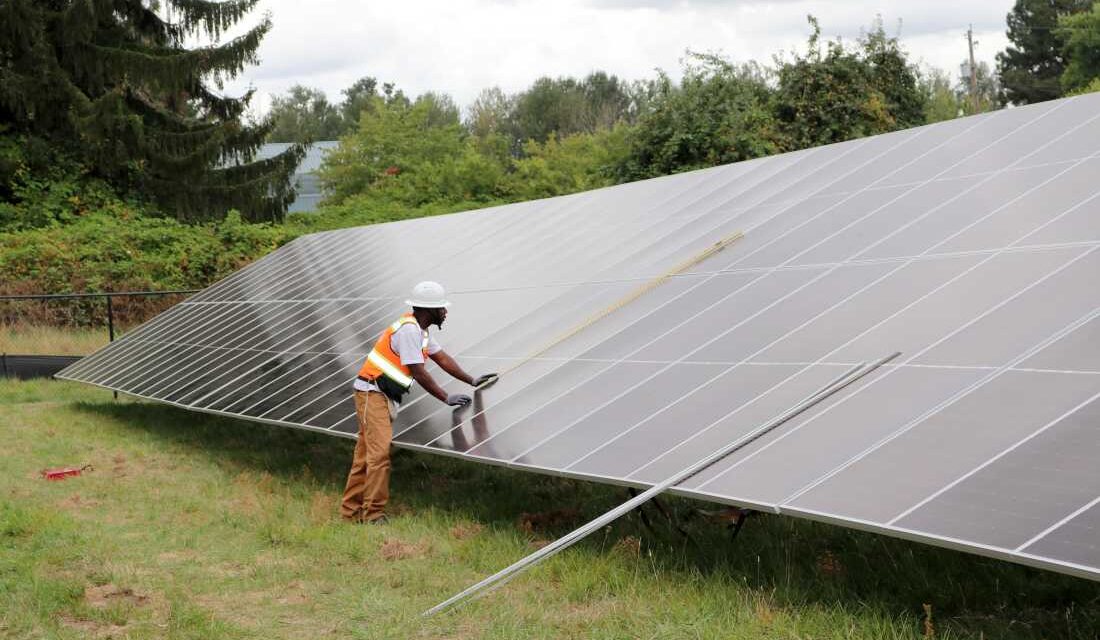
The PDX Community Solar project, supported by over $4 million from the Portland Clean Energy Fund, delivers power to low-income residents in Portland, Oregon’s Cully neighborhood. This effort reflects a broader initiative to advance climate solutions despite federal inaction. Across the US, states, cities, and communities are actively working to reduce climate pollution and adapt to extreme weather.
Portland’s Climate Initiatives
Over the past seven years, Portland, Oregon, has developed projects aimed at reducing emissions and energy costs for low-income families. Efforts include a community solar project assisting 150 families, distributing 20,000 free air conditioners, and implementing energy efficiency upgrades in 3,100 homes. Additionally, 2,000 individuals have received training in renewable energy and construction fields.
These projects are funded by the Portland Clean Energy Fund, a billion-dollar initiative focusing on racial, social, and climate justice. This fund assists vulnerable residents in adapting to climate change while reducing carbon emissions. The measure was passed by 65% of voters in 2018, and in 2019, a 1% retail sales tax on large corporations was instituted, generating the necessary funds.
How the Fund Operates
The fund collects a small percentage of each sale from major corporations, raising about $1 billion so far and projected to reach $1.6 billion by mid-2029. According to Sam Baraso, the program manager, the fund aims to expand local climate solutions addressing real-world climate challenges, community resilience, and economic stability.
The fund’s creation was rooted in the initiative of community leaders from nonprofits serving communities of color. These leaders sought ways to generate money for climate action, especially as funding was limited. They devised the idea of taxing large corporations to support climate action for those most affected by climate change.
Achievements
Some tangible results from the fund include:
- Distribution of over 20,000 free portable air conditioning units
- Community solar project reducing emissions and energy costs for 150 families
- Planting 15,000 trees over five years in urban heat areas
- Turning six concrete parking lots into urban gardens and green community spaces
Since 2021, the fund has provided four rounds of grants amounting to $262 million. These grants are helping to decrease greenhouse gas emissions and increase community involvement. Completed projects have reduced 25,500 metric tons of carbon emissions, comparable to removing 6,000 gas-powered vehicles from the roads for a year. This impact is expected to grow as more projects commence.
Debates and Future Plans
The substantial revenue from the Portland Clean Energy Fund has sparked debates on its allocation. Proposals like renovating the Moda Center with green technology and hiring more police officers have surfaced, prompting discussions on the fund’s focus on vulnerable communities.
The fund has inspired other cities, such as Ann Arbor, Denver, and Seattle, to pursue similar initiatives. Each city faces its own challenges, leading to adaptations like sales tax or property tax increases.
Amruta Nori-Sarma from Harvard T.H. Chan School of Public Health emphasizes the importance of local engagement in developing climate funds. She notes cities must identify viable solutions based on community input.
The Portland Clean Energy Fund is anticipated to complete its first five-year plan by mid-2029, contributing $1.6 billion to local climate projects.
 Atlantic Ends September Without a Hurricane for First Time Since 1994
  Bobcat Sightings and Conservation Efforts in Illinois
  2026 El Niño: A Historical Comparison and Future Projections
  U.S. Records Warmest September in History
  Swiss Glaciers Show Effects of Ice Loss Amid Global Warming
  Climate-Resistant Rock Glaciers: Hidden Water Resources