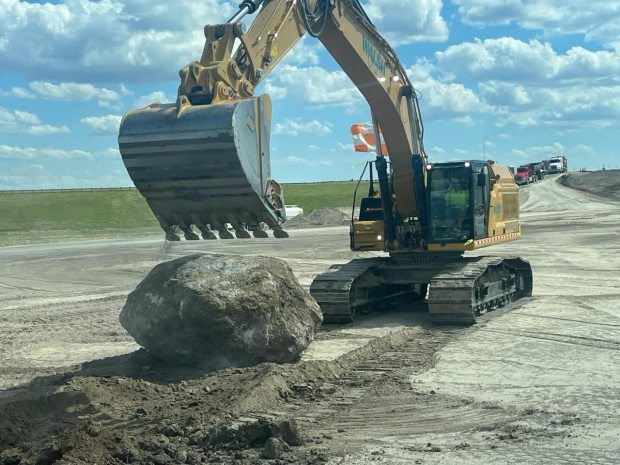
Ron Pitelka was 23 when he brought his first boulder home from work. While working at a construction site in Chicago’s southwest suburbs, Pitelka discovered an egg-shaped limestone rock about 5 feet wide. With his first dump truck, he transported the 10,000-pound boulder.
Over the last two decades, the 45-year-old Local 150 excavator operator has gathered several hundred rocks. Some remain at his mom’s place in New Lenox, while around a hundred lie at his home in Homer Glen, southwest of Chicago. These rocks line his house and driveway.
“My neighbors hate me for it,” Pitelka jokes about his collection.
None of Pitelka’s rocks compares to the massive discovery this summer at O’Hare International Airport. Working with bulldozer operator Matt Tracy, Pitelka unearthed a 50-ton boulder 30 feet underground using his Caterpillar 352 excavator. The rock was found during excavation for O’Hare’s $8.8 billion terminal modernization project.
Cortney Harris, project manager with the Chicago Department of Aviation, shared that the rock emerged from excavation near the airport’s stormwater detention basins. A professional geologist identified the boulder as dolostone, a sedimentary carbonate rock related to limestone. Dolostone forms the bedrock of Illinois and became the state’s official rock after campaigning by suburban elementary school students.
The Aviation Department began a contest inviting public submissions to name the boulder. Names received include Da Layover, Jean Baptiste Point du Pébble, Ferris Boulder, and The BaRock Obama Presidential Memorial Airport Boulder. Staff will choose finalists, and the public will vote for the winner.
Pitelka learned of the contest through a neighbor and expresses excitement. He notes that contractors often prefer to bury or break boulders due to lower costs. Pitelka recalls a set of stunning blue granite boulders buried in Plainfield.
“It makes me sick to my stomach,” he said.
Pat McLaughlin, principal research scientist with the Illinois State Geological Survey, explained that Illinois dolostone dates back over 400 million years. It formed when the Chicago area was tropical. Seashells secreted by sea creatures accumulated and transformed into limestone, then dolostone.
Glacial movements shaped the dolostone into large chunks, leading to the O’Hare boulder’s creation 12,000 to 15,000 years ago. Clara Blättler, an associate professor from the University of Chicago, mentioned examining the rock for fossils could pinpoint its age.
The boulder is now publicly displayed at the O’Hare Multi-Modal Facility, which hosts rental car operations, a people mover stop, and Metra and Pace connections.
Pitelka’s family ties to excavation run deep, with his father and uncle being contractors and his starting work at age six. His fascination with boulders began in childhood, and as an adult, he enjoys the discovery process.
“Excavating requires skill, focus, and at times is stressful. But it can be really fun,” Pitelka expressed.
Chicagoans have just over a week to suggest names for the boulder. Pitelka advocates for a simple name devoid of celebrity or political tones. He would name it “Geo,” highlighting the rock’s geological nature and enduring presence.
 The Threat of Melting Glaciers: A Call to Action
  Climate-Resistant Rock Glaciers: Hidden Water Resources
  California Voters to Decide on $7.5 Billion State Research Fund
  Ancient Pottery Unearthed During Roadworks in Tbilisi
  U.S. Space Academy Announcement
  The Need for New Strategies in Oregon’s Wildfire Management