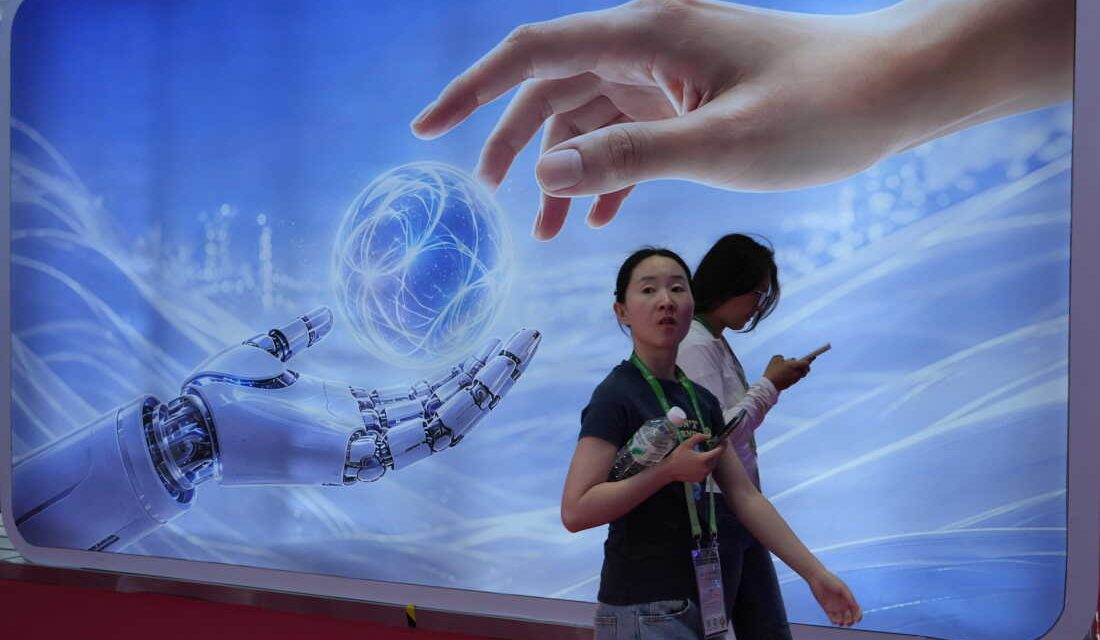
Visitors walked past a display featuring artificial intelligence and a human hand at the China International Supply Chain Expo in Beijing on June 22, 2026. This follows a statement from China’s Ministry of Foreign Affairs countering a proposal by Anthropic’s CEO, Dario Amodei, for the U.S. to limit China’s AI capabilities. Amodei argues for a global slowdown in AI development, claiming a Chinese lead in AI could threaten the U.S. and global stability.
U.S. President Donald Trump and Chinese leader Xi Jinping are expected to discuss AI governance at their meeting on September 24. Amodei’s recent essay advocated for maintaining restrictions on selling advanced AI chips and equipment to China, emphasizing the importance of the U.S. retaining its AI leadership.
China’s Ministry of Foreign Affairs criticized Amodei’s suggestions, calling for international cooperation. Spokesperson Guo Jiakun remarked, “Fearmongering and competition disrupt global AI governance, which benefits no one.” On the same day, President Trump dismissed urges to decelerate AI development, expressing confidence in U.S. leadership, stating, “whoever wins AI, wins.”
Amodei warned that AI “agents” might dominate the internet within months without efforts to slow development. He stressed that slowing global AI development requires China’s cooperation, a country with significant AI advancements.
Summit Meeting on AI Governance
The anticipated discussions between Trump and Xi during their September summit include AI governance. Chinese AI models have rivaled U.S. technologies in capability and cost-effectiveness. President Xi proposed creating a global AI governance framework and advancing an open-source AI community in the Global South. Meanwhile, China’s Ministry of State Security urged swift action for establishing systems to manage AI security risks.
Editorials and Anxieties
“Amodei’s essay is a ‘Cold War playbook’ for the AI sector,” accused China’s state-run Global Times, suggesting containment motives. The essay was criticized amidst recent advisories by U.S. agencies alleging malicious practices by Chinese AI developers.
China’s Commerce Ministry rejected U.S. allegations of distillation practices, asserting the U.S. aims to monopolize AI. The ministry described distillation as common in AI industries.
Lizzi C. Lee of the Asia Society Policy Institute remarked on the evident tension: “Both China and the U.S. aim to prevent the other from creating a tech stranglehold. This leaves Beijing questioning how to balance cooperation on safety with restricted access to AI resources.”
 Police Discover Ancient Roman Artifacts Off Sardinian Coast
  Urgent Need for Action in East Africa’s Food Crisis
  Suspected Plague Death in Siberia Sparks Health Measures
  Meta’s Muse AI Assistant Sparks Cybersecurity Concerns
  G7 Nations Agree to Release 100 Million Barrels of Oil Amid Fuel Price Surge
  Co-Pilot Attempts Hijack on Flight to Tel Aviv