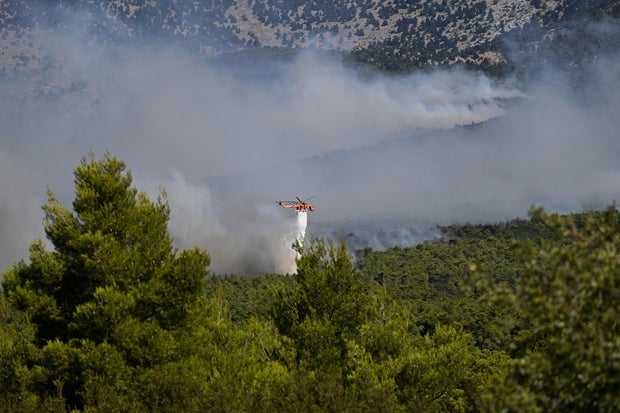
On Sunday, a tragic incident occurred in Greece when two firefighting helicopters collided in midair while battling a wildfire west of Athens. The helicopters were Bell models, each manned by a two-person crew. The collision resulted in one helicopter crashing to the ground, killing two crew members—a Greek and a Danish national. The other two crew members, a Greek and a British national, survived.
The collision underscored the critical danger firefighters face in combating Europe’s wildfire emergencies. Strong winds in the area exacerbated the situation, forcing evacuations as flames spread deeper into the region near Athens.
The wildfire started on Friday near Agios Vasileios and quickly moved towards Porto Germeno and the forested mountains west of Athens. Authorities evacuated many people by sea—254 individuals on Friday and another 12 on Saturday—as fire and smoke closed off road routes from coastal communities.
Efforts to control the fire were substantial, involving nearly 500 firefighters and 23 aircraft. However, gale-force winds hindered some aircraft from collecting water from the sea, allowing the flames to spread rapidly through dry forests. This posed a significant threat to various communities and industrial districts in western Attica.
Authorities ordered evacuations of areas like Kandili, Agia Skepi, and Toutouli amid growing concern, particularly for Porto Germeno. Greek Prime Minister Kyriakos Mitsotakis remained informed about the ongoing operations.
In other parts of Greece, wildfires also threatened homes on the island of Kefalonia, leading to evacuations as firefighting aircraft conducted water drops. Another blaze near Nea Tenedos in Halkidiki required significant firefighting efforts.
Earlier in the week, three firefighters lost their lives combating fires—two in Crete and one in the Peloponnese. Local farmer Minas Tzortzanis lamented the destruction, saying, “A pristine forest, a paradise, was surrendered to the hands of the fire.”
The wildfire situation extends beyond Greece, with France and Spain experiencing severe fires that displaced around 250,000 people, emptying communities amid the peak of the summer season. Emergency services are stretched thin across simultaneous disasters.
Europe faced its worst fire year on record in 2025, with over 3,860 square miles burned. According to the European Environment Agency, wildfires have been linked to nearly 800 deaths over the past four decades.
As the fastest-warming continent, Europe’s temperature rise surpasses the global average since the 1980s, according to the EU’s Copernicus Climate Change Service. Human-induced climate change has intensified fire-weather conditions, such as those in France, making them significantly more likely, as per an analysis conducted by World Weather Attribution.
 Police Discover Ancient Roman Artifacts Off Sardinian Coast
  Urgent Need for Action in East Africa’s Food Crisis
  Collapse of Hawai’i’s Hōlei Sea Arch Amidst Storms
  Suspected Plague Death in Siberia Sparks Health Measures
  Los Angeles Faces Uncommon Heatwave in October
  G7 Nations Agree to Release 100 Million Barrels of Oil Amid Fuel Price Surge