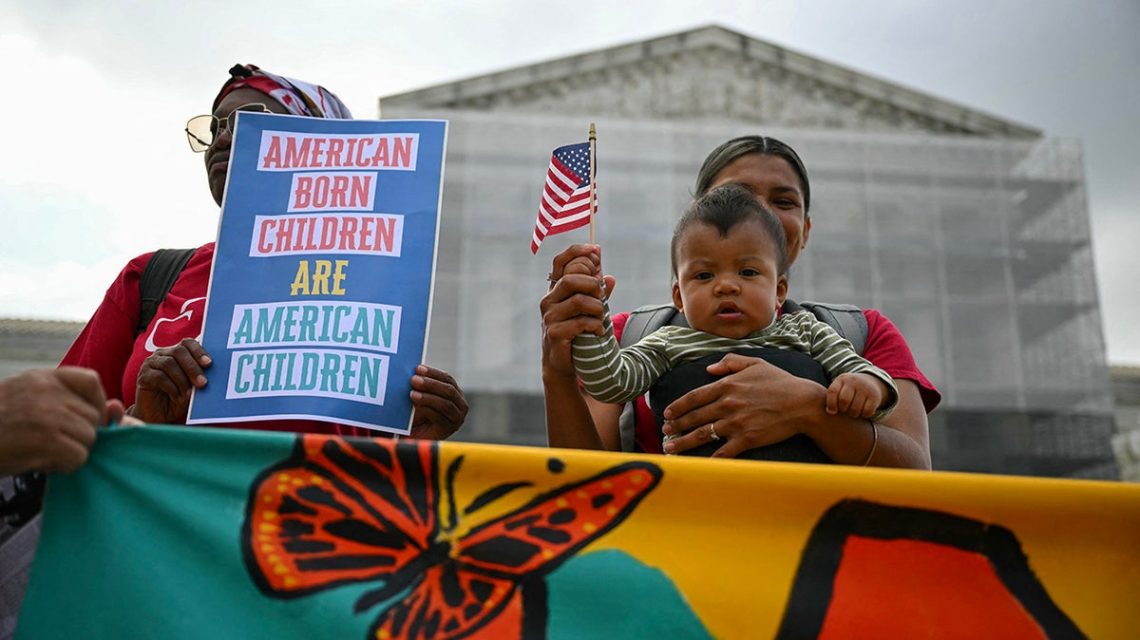
Conservative legal experts suggest President Donald Trump’s recent actions to limit birthright citizenship and address birth tourism may have stronger legal support compared to earlier efforts. Following a Supreme Court decision in June affirming citizenship at birth for children born in the United States to unlawfully or temporarily present parents under the 14th Amendment, Trump introduced two executive orders with more focused approaches.
New Executive Orders
On August 6, Trump signed an order directing federal agencies to withhold citizenship documents from children born without U.S. citizen parents, including those whose parents are members of recognized foreign terrorist groups or involved in schemes to secure birthright citizenship. This narrower order is viewed by right-leaning organizations such as the Manhattan Institute and America First Legal as potentially fitting long-standing exceptions to birthright citizenship.
“The Supreme Court has historically recognized exceptions for children of invading armies or ambassadors under the 14th Amendment,” said Chad Mizelle from the America First Policy Institute. He emphasizes the legitimacy of exceptions for terrorists operating against U.S. laws.
Historical precedent comes from the 1898 Supreme Court case United States v. Wong Kim Ark, which acknowledged exceptions for diplomat children and alien enemies born during hostilities. Trump’s order argues that foreign terrorist organization members fall into the enemy category.
Legal Debate and Challenges
David Bier from the Cato Institute raises legal concerns, arguing that defining alien enemies outside congressional authority could be legally unstable. Amanda Frost from the University of Virginia School of Law highlights that only children of enemies “occupying” U.S. territory are generally excluded, suggesting Trump’s order might be too broad.
Critics believe the executive order oversteps constitutional bounds by attempting to alter established legal interpretations without Congressional involvement. Some experts speculate this focus diverges from previous legal challenges.
Legal standing, the criteria for challenging the order, is uncertain. According to Gene Hamilton from America First Legal, who might claim harm under these definitions is unclear.
Second Order and Its Justifications
A second order issued the same day targets birth tourism, mandating visa denials or removals for individuals entering the U.S. to secure citizenship for children born here. Hamilton defends the legality, referencing Section 215(a) of the INA, granting authority to manage visa issuance.
“It’s a sovereign right of governments to decide visa eligibility,” Hamilton explains. “No constitutional entitlement to a visa exists.”
Concerns arise that existing measures are adequate for combating birth tourism. Critics argue the administration has previously exploited constitutional immigration language.
Future action might require either congressional effort or constitutional amendments for further changes. Legal experts suggest the administration’s targeted approach might have previously succeeded with the Supreme Court.
 Trump’s 2024 Reelection and Evolving Voter Dynamics
  Defense Secretary Emerges as Key Player in the Trump Administration
  Hegseth’s Vision for the Military: Balancing Tradition and Innovation
  Significant Funding Boosts Ken Paxton’s Texas Senate Campaign Amid Tight Race
  U.S. States Extend Gas Tax Waivers Amid Rising Fuel Costs Due to Iran Conflict
  USCIS Raises Immigration Fees