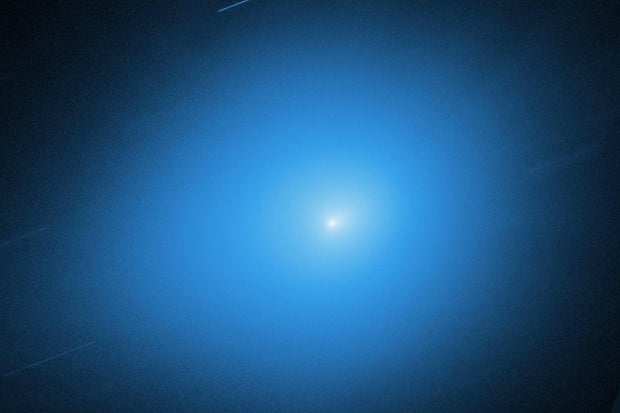
Scientists have identified an extraordinary interstellar comet named 3I/ATLAS, which passed by the sun and Earth last year. This comet is notably different from anything previously observed within our solar system.
An Ancient Visitor
3I/ATLAS stands out not only for its origins beyond our solar system but also its potential age. The comet might be up to 12 million years old, surpassing the estimated 4.5 billion-year age of our solar system. NASA’s Martin Cordiner noted it might be “the oldest object to have been observed in our solar system.”
Revealing Observations
Using instruments like the James Webb Space Telescope and the ALMA observatory in Chile, researchers analyzed the comet’s isotopes. These findings reveal a chemical makeup distinct from known solar system bodies. The isotopes suggest a high deuterium level, indicating formation in an extremely cold environment, around minus 243 degrees Celsius.
“The high abundance of heavy water can only occur in a very cold environment,” Cordiner explained.
Puzzle of Origins
The precise origins of 3I/ATLAS in the Milky Way remain unknown. It might have been ejected during a planet’s formation and spent billions of years traveling vast distances without orbiting a star. The comet may originate from the “cosmic noon” period when star formation was intense, approximately 10 billion years ago.
Scientific Breakthrough
Unlike previous interstellar encounters, scientists gathered isotopic evidence from 3I/ATLAS. Past visitors, 1I/’Oumuamua in 2017 and 2I/Borisov in 2019, weren’t bright enough for such analysis. Released images showed the comet in various stages of its journey, including a November snapshot when it was about 180 million miles from Earth.
There have been speculative debates about the comet’s nature. Avi Loeb of Harvard University suggested it could be more than a mere rock or comet. Nevertheless, NASA and the SETI Institute have found no evidence of extraterrestrial technology.
Future Prospects
Astronomers acknowledge the study is groundbreaking, yet the comet’s exact age remains uncertain. With 3I/ATLAS leaving the solar system, further direct observations will become challenging. However, the Vera C. Rubin Observatory in Chile is expected to aid in discovering more interstellar objects in the future.
As this field develops, researchers anticipate gaining deeper insights into our galaxy through these cosmic visitors. This comet represents merely the beginning of an exciting era in astronomy.
 Climate-Resistant Rock Glaciers: Hidden Water Resources
  California Voters to Decide on $7.5 Billion State Research Fund
  Ancient Pottery Unearthed During Roadworks in Tbilisi
  U.S. Space Academy Announcement
  The Need for New Strategies in Oregon’s Wildfire Management
  Plastic Pollution in the Great Lakes: A Growing Concern