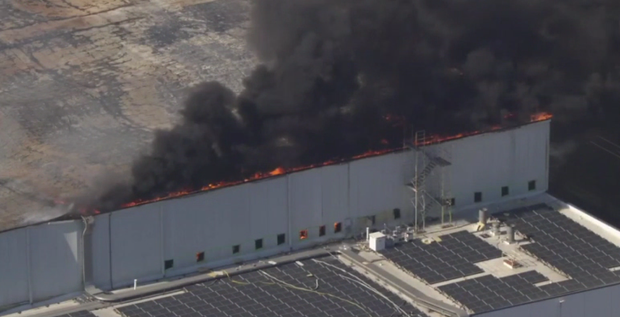
Firefighters faced renewed challenges Saturday at the Lineage Big Bear cold storage facility fire in Boyle Heights. Conditions remain highly complex, prompting Mayor Karen Bass to declare a local emergency to support efforts. The fire was initially reported on Wednesday at the 500,000-square-foot facility on Los Palos Street, used for storing frozen foods.
Fire’s Impact on Facility
L.A. Fire Chief Jamie Moore described the structure as akin to a giant cooler, built with corrugated steel walls filled with dense foam insulation and reinforced interior steel panels. Ammonia in its refrigeration system helped maintain the necessary temperatures for frozen food storage and potentially fueled the fire when it started. Moore explained during a news conference that they achieved partial control over the fire with water-dropping helicopters, covering approximately half of the building. The unaffected portion contains thawing food since refrigeration was turned off, and ammonia removed. The building’s internal temperature stays around 45 degrees due to insulation. Moore highlighted how dense foam burns slowly, complicating fire control efforts.
Strategies to Control Fire
Continuous helicopter water drops help to cool the structure and prevent further escalation. Large aerial ladder pipes have also directed thousands of gallons of water per minute onto it. Moore noted the use of contract helicopters capable of dropping around 3,000 gallons of water at once, alongside blaze tamer gel, which encapsulates smoke and smothers the fire effectively. Despite efforts, aerial footage revealed a flare-up on the roof on Sunday.
Complications and Challenges
With 85 million pounds of frozen food inside, firefighter access is limited due to zero visibility and unstable interior conditions. As food begins to rot, biohazard concerns emerge, given the presence of chickens, beef, pork, and fish. LAFD crews focus on isolating unaffected areas and evaluating safe removal methods. While hazardous materials are largely mitigated, potential biohazards from spoiling goods remain a priority.
Health and Safety Concerns
No injuries, evacuations, or shelter-in-place orders are reported, although residents sensitive to air quality are advised to stay indoors. Mayor Bass stressed smoke concerns, especially due to chemical additives for food preservation. Two shelters are available for affected individuals, with masks and air filters being distributed. Governor Newsom might join Bass in issuing a joint emergency declaration.
Official Response and Assistance
Mayor Bass’s emergency declaration aims to secure resources, coordinate response efforts, and obtain state and federal assistance. The Emergency Operations Center is activated, seeking waivers of regulations that might hinder response and recovery. LA County Supervisor Hilda Solis expressed concern over the radius extending to 2.5 miles, affecting numerous households.
Environmental Impact Concerns
Residents question potential long-term environmental and health impacts. Air quality concerns persist, with particle pollution advisories extended. Lineage Logistics stated the fire might have originated from solar panel testing by a third-party contractor. Measures to remove ammonia minimize risks. Authorities emphasize the ongoing challenge to extinguish the fire completely, which could take days or weeks.
Reporting Air Quality Issues
Residents noticing odors or smoke are encouraged to report them to the South Coast Air Quality Management District via hotline or online system. For current air quality updates, visit the South Coast AQMD website or download their app.
 Teen Left in Critical Condition After West Ridge Shooting
  Death of Kenan ‘Ken’ Urker, Partner of Gypsy Rose Blanchard
  Luigi Mangione’s Guilty Plea and Ongoing Legal Battles
  Cargo Plane Crash at Miami International Airport
  Marine Veteran Suing Oregon School District Over Curriculum Reimbursement
  Tennessee Execution Halted as Issues Persist with Lethal Injection Protocol