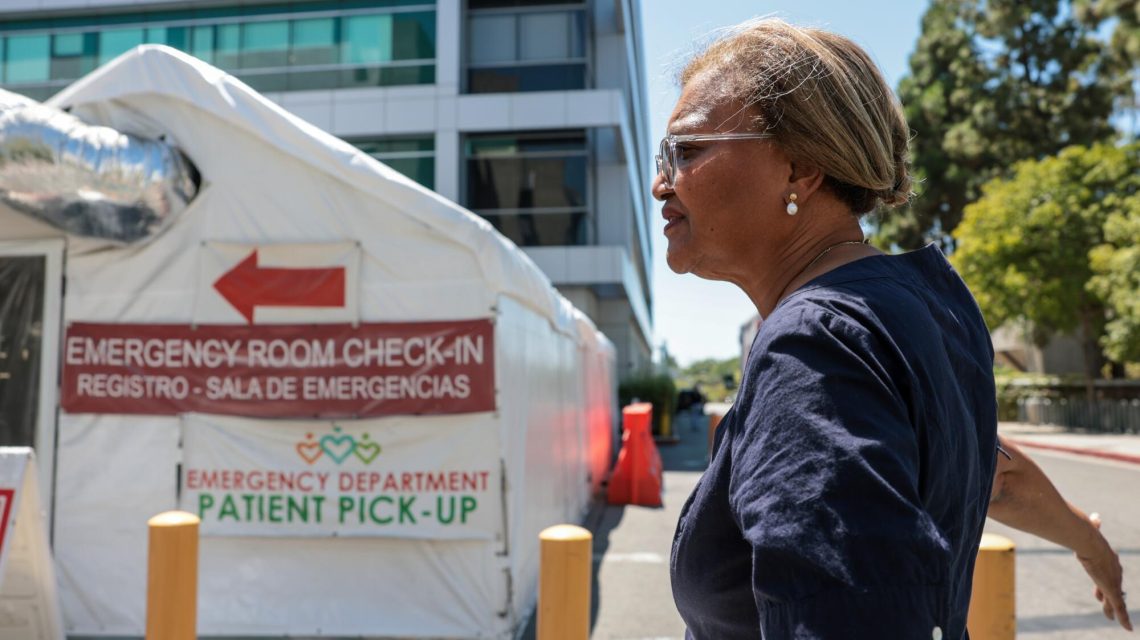
Martin Luther King Jr. Community Hospital in Willowbrook stands as the primary emergency medical facility for many residents of South Los Angeles. However, due to limited space, numerous patients receive treatment in tents outside. These large metal-frame tents are reminiscent of the temporary setups used early in the COVID-19 pandemic. The situation highlights the hospital’s urgent financial difficulties, with leaders warning that closure is possible if revenue doesn’t increase substantially.
The hospital reported $14 million in net income for a recent fiscal year but had financial losses in the prior three years. With upcoming changes from the 2025 One Big Beautiful Bill Act affecting Medicaid, the hospital expects to lose between $80 million and $100 million annually. Despite being located in a wealthy area within the wealthy United States, the hospital struggles to meet patient needs with limited resources.
MLK hospital’s leaders urge the Los Angeles County Board of Supervisors to reevaluate the distribution of Measure B funds. This property tax helps support trauma centers and emergency services. In fiscal year 2025, the measure generated around $427 million. However, these funds predominantly benefit county hospitals and private hospitals with trauma centers, leaving facilities like MLK, without trauma centers, competing for extra funds.
Between 2023 and 2025, MLK hospital required state and county assistance totaling $68 million. Only $29 million came from one-time Measure B funds. Since its reopening as a nonprofit facility in 2015, MLK hospital hasn’t received ongoing Measure B support. Last year, $126 million of the measure’s funds went to 13 private trauma centers, including Cedars-Sinai Medical Center, which opposes major changes to fund allocation.
MLK hospital operates beyond capacity, treating emergency patients in hallways, doubled-up rooms, and converted spaces. Suggestions for renovating under-utilized areas on its campus have been financially unfeasible, so tents are used to manage overcrowding. The hospital’s emergency department, with 29 beds designed for 25,000 visits annually, now handles over 120,000.
Dr. Elaine Batchlor, MLK’s CEO, emphasizes the need to reconsider how Measure B funds are distributed. She argues that funds should prioritize hospitals serving financially struggling communities. MLK hospital’s emergency department serves a predominantly Medicaid/Medi-Cal or uninsured population, making it financially vulnerable.
If MLK hospital were to close, the impact on the South LA community would be severe. Financial insecurity in the area is high, with the hospital recording nearly 85,000 Medicaid/Medi-Cal visits in 2023, the most in California. By contrast, Cedars-Sinai had about 17,000. Pastor Robert Taylor advocates for redistributing funds to better serve community needs.
Los Angeles County Supervisor Holly Mitchell proposes hiring a consultant to assess Measure B fund allocation. She highlights that MLK hospital serves a large volume of emergency patients despite financial instability. Ensuring the balanced support of hospitals is crucial for maintaining a robust emergency care system.
 Increased Funding Needed for Psychiatric Hospitals
  Trump Administration Distributes ACA Refund Checks
  Higher Consumption of Ultra-Processed Foods Linked to Increased Health Risks
  Understanding Inflammation: Myths and Facts
  Calm Parenting: Strategies to Manage Stress
  Trump’s Executive Order to Combat Mosquitoes and Ticks in D.C.