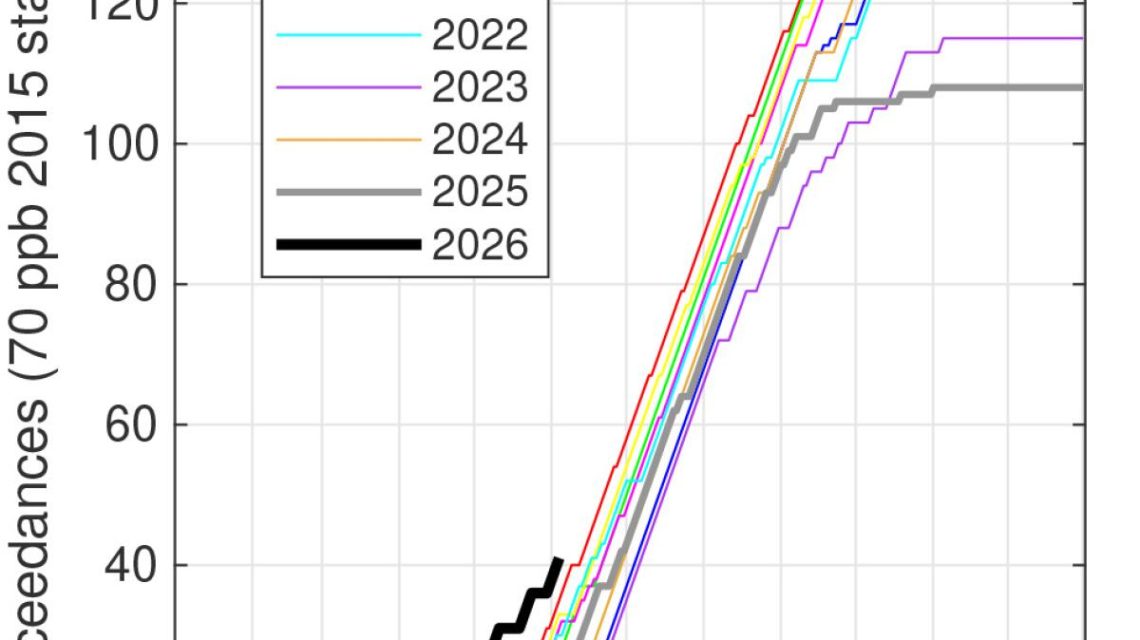
The start of 2026 has marked a significant deterioration in air quality across Southern California. In the first five months, the region experienced the highest number of unhealtful air days in over ten years, as reported by state air monitoring.
The South Coast air basin, covering Los Angeles, Orange, Riverside, and San Bernardino counties, recorded 39 days where ozone levels surpassed federal standards. In comparison, the previous infamously hazy year of 2017 had 36 of such days by early June and finished with 145. The approximately 18 million residents in the area face various health risks from exposure to ozone, which is a corrosive gas linked to asthma and respiratory issues.
Adrian Martinez, director of Earthjustice’s Right to Zero campaign, voiced concerns over the increasing frequency of smog violations. “This could be a really awful year for air quality,” Martinez warned, highlighting that the region already suffers from severe summertime smog pollution. He referred to the current year as potentially being one of the worst among the most affected areas nationwide.
Impact of Natural Conditions
The valleys experienced severe pollution, with Reseda in the San Fernando Valley recording the second-highest spike in hourly ozone levels in the past decade. The South Coast Air Quality Management District attributes this spike to early heatwaves. Despite the high temperatures, officials have not noticed a rise in pollutants typically contributing to ozone formation.
According to the National Weather Service, local temperatures surged past normal levels, with March of this year being the warmest ever recorded in California. Riverside experienced temperatures above 90 degrees for 13 days. Sarah Rees, a deputy executive officer of the air district, remarked, “We saw conditions typical for July or August in March.”
The district encourages residents to check pollution levels through their website and app and to minimize outdoor activities when smog increases. Scott Epstein, manager of planning and rules at the air district, pointed out that unlike visible smoke from wildfires, ozone is more insidious and harder to detect.
Historical Context and Future Steps
Southern California has long struggled with smog due to emissions from millions of gas-powered vehicles mixed with abundant sunshine, creating a perfect environment for smog formation. Mountains enclosing the area exacerbate the issue by trapping pollution.
Sufficient air quality improvements have been made. State and local regulators enacted initiatives like the nation’s first tailpipe emission standards in 1966. Catalytic converters became mandatory in 1975. Thanks to these measures, smog-related pollution has significantly decreased over two decades. Nevertheless, the region still does not comply with federal ozone standards.
During a recent meeting in Diamond Bar, the air district’s governing board honored the late William Burke, a former chair known for significantly advancing environmental regulations. “Emission reductions don’t fully convey the impact on community health,” said air district Chair Michael Cacciotti.
Residents from the Inland Empire, among those most afflicted, acknowledged the positive changes but urged for continued progress. Erik Morden, a resident, alluded to past intense pollution, noting, “There’s still a lot of unseen particulates causing issues.”
Martinez emphasized the need for increased government action. “We shouldn’t over-complicate it. We’ve got a lot of heat, we’ve got a lot of pollution,” he said, advocating for incentives to aid the transition to zero-emission appliances.
 Swiss Glaciers Show Effects of Ice Loss Amid Global Warming
  Climate-Resistant Rock Glaciers: Hidden Water Resources
  Senators Reach Bipartisan Agreement on Permitting Reform
  Experts Warn of Critical Period for the Colorado River
  Future Cities: Ambitious Projects Aiming for Innovation and Sustainability
  Supreme Court Case Suncor vs. Boulder: Implications for Accountability in Climate Change