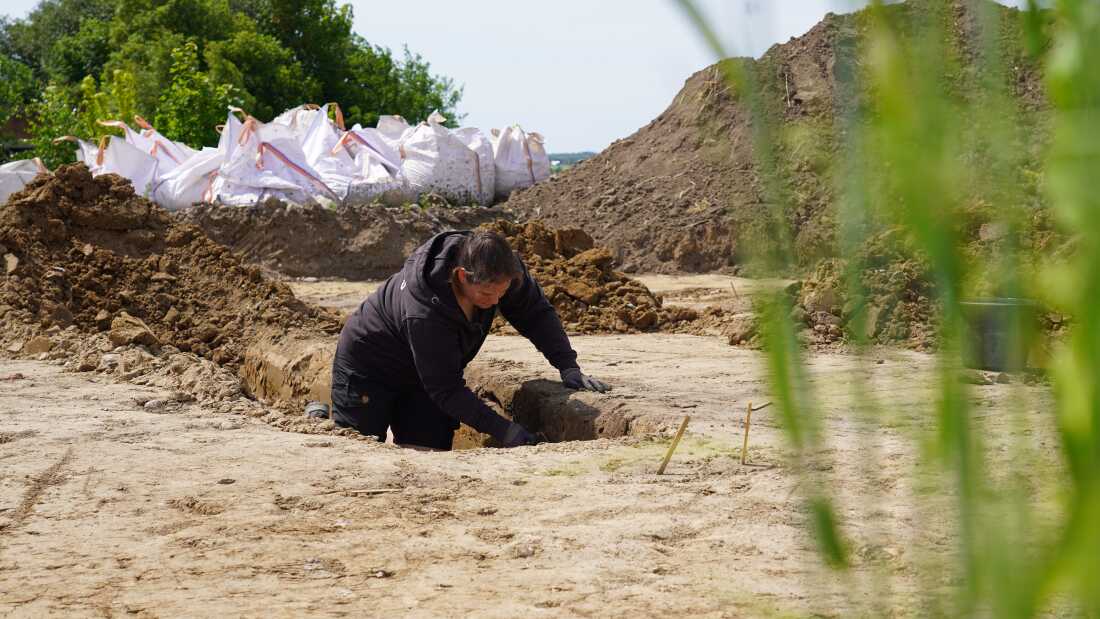
On June 22, 2026, a significant archaeological discovery was made in Søften, Denmark. Archaeologists revealed a vast Viking Age textile production site over 1,000 years old, showcasing the complexity of Viking society. The Moesgaard Museum experts reported that the site covers 100,000 square meters (more than 1 million square feet) and features an area for flax processing, along with more than 80 pit houses. These semisubmerged structures served as workshops and residences in Viking times.
Situated 10 kilometers (6 miles) north of Aarhus, Denmark’s second-largest city, the site dates back to the late Iron Age and early Viking Age, between A.D. 600 and 950. Archaeologist Liv Stidsing Reher-Langberg led the 10-month excavation. “We have a clear focus on textile production, which distinguishes this settlement from others of the era,” she noted.
Reher-Langberg explained that the pit houses contained spindle whorls and weight looms, indicating textile activities. Additionally, discoveries included silver coins, glass beads, and pottery. Separate areas for production and crafts were identified, along with a single residential home, implying oversight by a powerful individual who controlled resources and production.
In recent years, metal detector enthusiasts found several silver coins in the vicinity. A trial excavation conducted 1½ years ago, prior to construction work on a new road and industrial area, sparked further archaeological interest. “The trenches revealed a continuation with pit houses and elements related to textile production,” Reher-Langberg stated.
Moesgaard Museum historian Kasper Andersen described the Søften discovery as “another piece in the puzzle” for understanding the local economic, cultural, and political structure at the time. During the Viking era, Aarhus, known as Aros, operated as a royal center and international trade hub. Just 4 kilometers (2½ miles) away, another Viking site in Lisbjerg was discovered last year, likely belonging to nobility.
Andersen suggested that goods and resources from settlements like Søften contributed to a broader international trade network. “A production site of this scale cannot be understood only as serving the local area; it is part of a larger network,” he emphasized.
Future analyses, including carbon dating and pollen studies, are expected to clarify details about textile production at the site. During the Viking Age, spanning A.D. 793 to 1066, Vikings engaged in extensive raids, colonization, and trade across Europe, reaching North America.
Andersen concluded that the discovery at Søften demonstrates that Vikings were “not simply uncivilized hordes.” He stated, “Søften reflects a well-organized society with a production line and a market beyond the local area.”
 The Threat of Melting Glaciers: A Call to Action
  Climate-Resistant Rock Glaciers: Hidden Water Resources
  California Voters to Decide on $7.5 Billion State Research Fund
  Possible 19th-Century Shipwreck Exposed by Nor’easter in Nantucket
  Ancient Pottery Unearthed During Roadworks in Tbilisi
  U.S. Space Academy Announcement