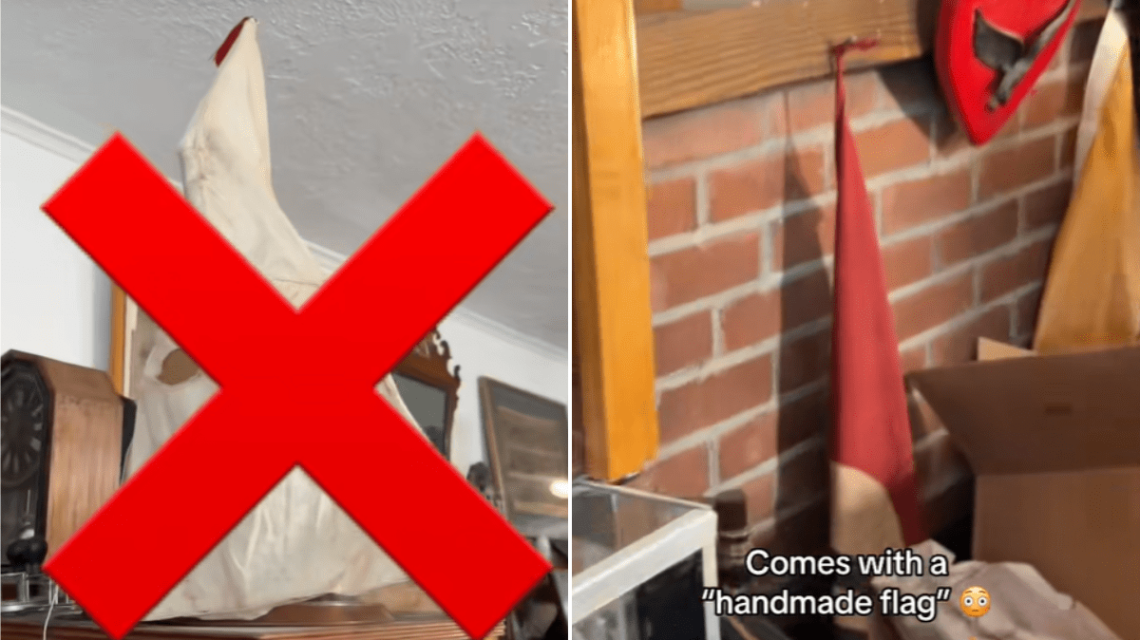
A recent discovery at an antique store in Sarasota County, Florida, has stirred significant attention. Liam McNamara, based in Venice and an avid thrifter, encountered what he describes as his ‘most disturbing thrift find ever.’
Unexpected Discovery at a Thrift Store
McNamara spends his days searching thrift stores for vintage decor to sell online. Upon a friend’s tip, he visited a local antique store where his friend had spotted a white conical hood, linked historically to the Ku Klux Klan (KKK). Although initially skeptical, McNamara decided to see for himself.
At the store, the item was indeed a KKK hood, priced at $350. McNamara learned it was obtained during an estate cleanout. The store owner mentioned the hood and a swastika flag were part of the acquisition. The owner noted the presence of KKK members on local beaches up until the 1980s.
Historical Context
The KKK was active in Florida during the 20th century, although by the 1980s, its influence had notably waned. Membership numbers dwindled compared to the peaks in the 1920s and 1960s. There is limited evidence of notable KKK presence or masked patrols during this later period despite some gatherings and rallies.
KKK hoods became symbols of intimidation and anonymity. In response, several U.S. states enacted anti-mask laws from the 1920s onward. While Florida’s laws do not ban such hoods outright, they prohibit using masks to conceal identity with an intent to intimidate.
Reactions and Implications
McNamara shared his find on TikTok, garnering over 1 million views and igniting a debate. Many viewers expressed opposition to the casual sale of such historical items. Some argued the hood belonged in a museum rather than private hands.
The hood sold for $450, purchased by someone intending to preserve it as a historical piece. McNamara’s experience highlights ongoing issues regarding the display and sale of hate symbols.
Legal and Ethical Considerations
The First Amendment protects the sale and display of extremist symbols like KKK imagery in the U.S. Despite this protection, private platforms such as Etsy and eBay have policies prohibiting items promoting hate. They restrict the sale of racist or extremist items unless deemed purely educational.
Independent stores, while legally able to sell these items, must navigate public sentiment and their policies. Instances of stores selling such memorabilia often result in backlash and sometimes lead to item removals.
 Tennessee Prison Chief Resigns After Botched Execution
  White House Announces Medicare-Linked Payments for Seniors
  Collapse of Hawai’i’s Hōlei Sea Arch Amidst Storms
  Northwestern Debuts New Ryan Field with Victory Over Penn State
  Concerns Over Contaminants in U.S. Cat Foods
  U.S. Initiates Military Operation on Southern Border