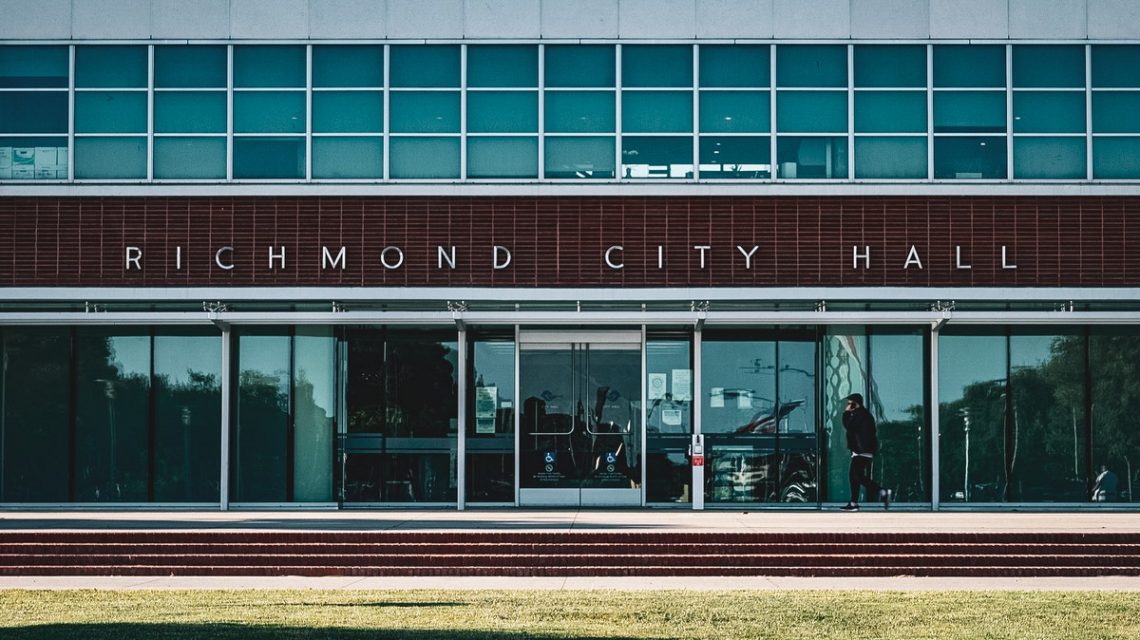
Just 30 minutes from San Francisco is the city of Richmond, California, which stands out as an uncommon political experiment. The city features a significant presence of democratic socialists within its governance. While Richmond resembles other working-class California cities, it hosts a unique political scene marked by the Richmond Progressive Alliance (RPA).
The RPA, formed in the early 2000s, has prominently influenced Richmond’s government for decades. Initially, the group aimed to challenge corporate power, oppose the Iraq War, and promote fair housing and rent control. Over time, its impact has grown, sparking concerns among residents about its approach to local businesses and economic development.
A view of Richmond City Hall shows the local government led by the Richmond Progressive Alliance. The coalition receives notable support from the East Bay Democratic Socialists of America.
– Nikolas Lanum/Fox News Digital
Mayor Eduardo Martinez, aligned with the RPA and affiliated with the Democratic Socialists of America, leads a progressive city council. He advocates for environmental justice and reducing corporate dominance but faces criticism for creating a business-hostile atmosphere. Martinez believes in diverse political perspectives and priorities common to residents, such as homelessness and job creation.
Former mayor Tom Butt, a long-serving city council member, notes a shift towards more liberal governance. Initially skeptical of the RPA, Butt later found their assistance valuable, particularly in tackling climate change and energy issues. However, he expresses concern about Richmond’s current direction under the RPA’s influence.
The RPA’s rise coincides with the city’s efforts to limit Chevron’s local political sway. Chevron operates a major refinery in Richmond and contributes significantly to local tax revenue. While RPA leaders demand the company pay more for its community impact, critics warn that alienating Chevron could harm the economy.
Supporters highlight the RPA’s successes in challenging Chevron, although the tension extends beyond the company. Butt describes Richmond as unfriendly to businesses, stating that entrepreneurs often feel isolated.
Kevin Brown, who lost his business after disputes with the city’s progressive government, criticizes what he calls an ‘anti-business’ agenda. He invested significantly in developing a waterfront winery but shuttered due to a rent payment conflict with the city during the COVID pandemic.
Martinez refutes claims of hostility, stating that the city prioritizes responsible corporate behavior and stakeholder protection. He argues that businesses portraying the city as adversarial often neglect their obligations.
Richmond business owners echo concerns about municipal cooperation. Angel Ramirez, whose family runs the popular Tacos El Rulas, stresses the importance of supporting small businesses. He finds permit processes frustrating, alleging delays in issuance.
Brown and others assert that ideology drives city leadership more than practical considerations. Martinez asserts that elected officials’ values guide their decisions, aiming to serve resident interests effectively.
The RPA folks have a vision and ideology, and it’s full speed ahead.
– Kevin Brown
Richmond exemplifies grassroots democracy, according to Martinez, who views it as a model for communities prioritizing inclusivity and responsible governance over corporate sway.
 The Trump Team’s Challenge to the Military Leadership
  Maryland First State to Restrict Electronic Pricing in Grocery Stores
  Activists Push for Nationwide Ban on Child Marriage in the U.S.
  Democratic Hopes and Historical Warnings in 2026 Senate Race
  Republicans Face Challenges Amidst Cost of Living Concerns
  A Different Kind of Fall for Congress This Year