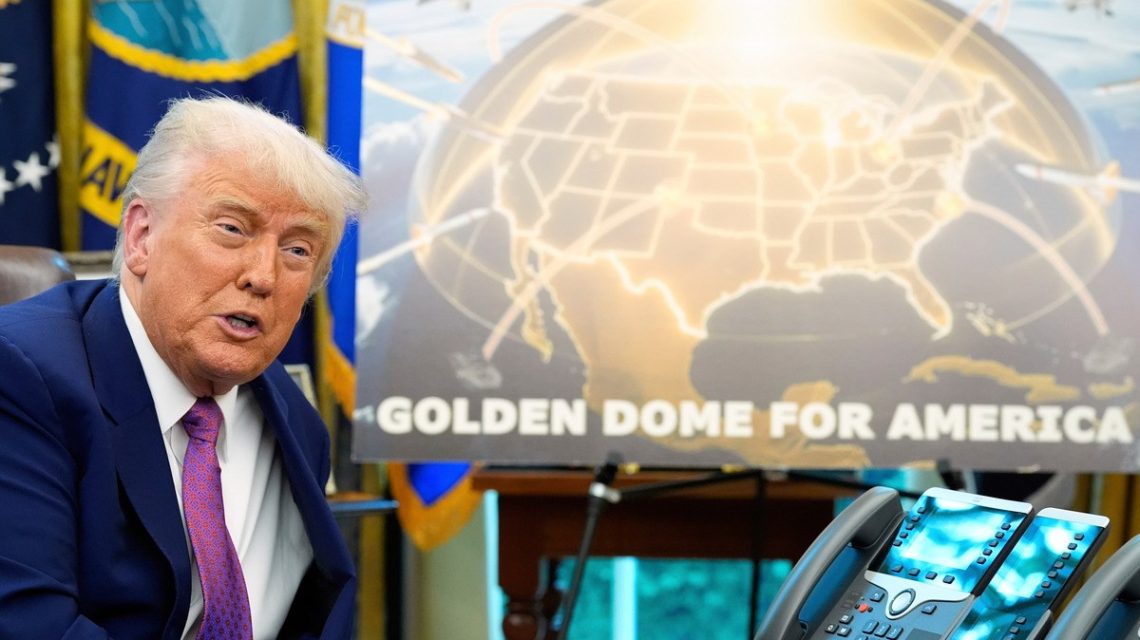
A senior Russian official has warned against President Donald Trump’s new defense strategies. The plans include the development of the Golden Dome missile shield and have been linked to a potential space arms race. Gennady Gatilov, Russia’s envoy to the UN in Geneva, expressed concerns about the militarization of space, describing the consequences as potentially ‘devastating’ for humanity. His comments were reported by the Russian state news agency, Tass.
Militaries globally utilize satellites for intelligence, communications, missile warnings, and navigation; however, the placement of weapons in orbit has been controversial for years. The Golden Dome’s design proposes using orbiting interceptors to neutralize incoming missile threats, with early-warning systems stationed in space. The U.S. government has not provided a detailed breakdown of the system’s components.
Leaders like Russian President Vladimir Putin and China’s Xi Jinping have jointly criticized the Golden Dome as a threat to strategic stability. North Korea also condemned the program, calling it ‘self-righteous’ and ‘arrogant.’ The U.S. government argues the project is necessary to defend against advanced missile threats, including hypersonic weapons. Both Russia and China have invested heavily in such technologies, outpacing the U.S. and NATO.
Despite technological advancements that support space-based defense systems, critics question the Golden Dome’s efficacy and its financial burden. The Congressional Budget Office (CBO) estimated that the project could cost about $1.2 trillion over 20 years, surpassing the initial $175 billion budget. The CBO suggested that the system might handle a small-scale assault but could be overwhelmed by a full-scale attack from Russia or China.
Several companies, including Lockheed Martin and Northrop Grumman, are competing to develop the space-based components. The U.S. Space Force aims to demonstrate an ‘initial capability’ by 2028. However, CBO official David Mosher noted a lack of transparency regarding the program’s details, indicating difficulties in obtaining briefings from the Pentagon.
Concerns extend beyond costs and capabilities. Democratic lawmakers, including Oregon Senator Jeff Merkley, criticized the plan for potentially triggering a nuclear arms race. The plan envisages coverage for the U.S. mainland, Alaska, and Hawaii, with discussions ongoing about including Canada. Canada would need to invest billions to join the defense umbrella, yet cooperation between U.S. and Canadian air defenses remains uncertain.
The Golden Dome’s strategy for handling drone threats remains unclear. The Pentagon’s National Defense Strategy emphasized cost-effectively countering large missile barrages and advanced aerial attacks. With the high costs of interceptors, militaries seek affordable methods to address major air threats. The Pentagon recently created a ‘hub’ with defense companies and investors to streamline defense procurement processes, aiming to reduce red tape.
 Angela Paxton Encourages Support for GOP Amid Personal and Political Turmoil
  Democratic Senators Discuss Potential 2028 Presidential Candidates
  Phil Collins Criticizes Trump, Talks Unwritten Song about America
  Byron Donalds Targets Black Voters in Florida Governor Race
  Brazil’s Presidential Race Heads to Runoff
  Sen. Thom Tillis Criticizes Trump’s Administration in New Book