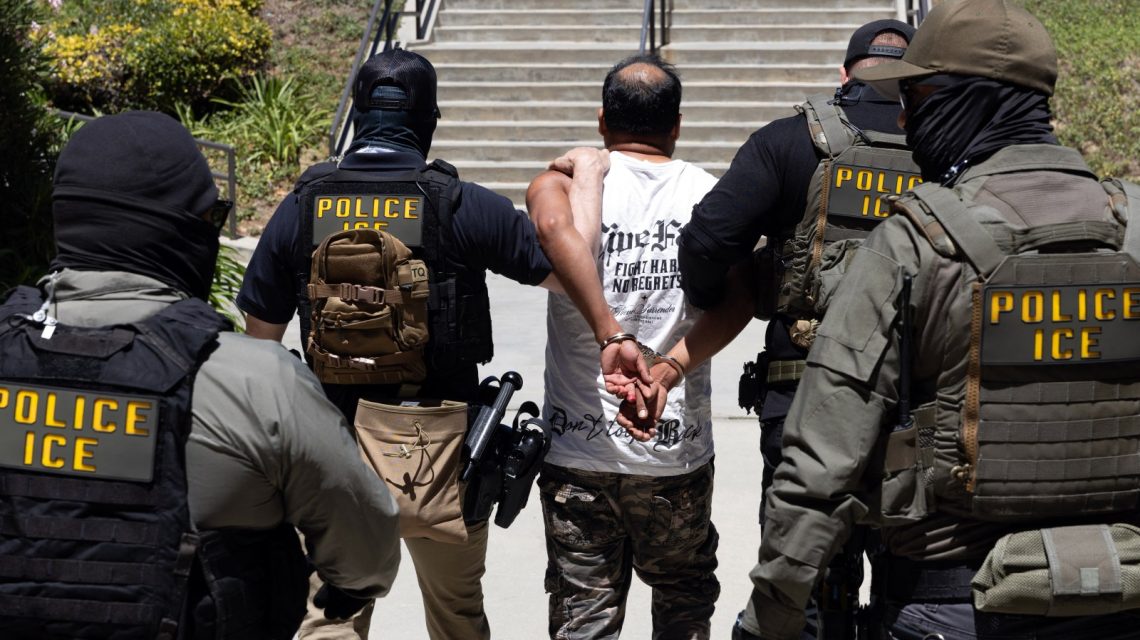
A recent study shows that during President Donald Trump’s second term, only one in three individuals arrested by U.S. Immigration and Customs Enforcement (ICE) had prior criminal convictions. This research, published in the Proceedings of the National Academy of Sciences, analyzed ICE arrests over more than a decade. The study revealed that while arrests increased under Trump, the proportion of those with criminal convictions significantly declined.
The Data Analysis
The study examined around 1.6 million ICE arrests from October 2015 to March 2026. It tracked arrest patterns across the Obama, Biden, and both Trump administrations. Findings showed that 34% of those arrested during Trump’s second term were convicted criminals, marking a decrease from 52% during President Joe Biden’s last year, 70% in the first year of Trump’s first term, and 79% in Obama’s final year.
“Our results reveal that the reality of immigration enforcement diverges sharply from the public narrative that ICE arrests are necessary to protect public safety by removing people who commit crimes,” said lead author Chloe East, an associate professor of economics at the University of Colorado Boulder.
During Trump’s presidencies, arrest rates surged significantly. In the first 14 months of Trump’s first term, ICE averaged 436 daily arrests, a 43% rise from Obama’s last year. Meanwhile, during the first 14 months of Trump’s second term, the average reached 952 daily arrests, a 214% increase from Biden’s last year.
Shift in Arrest Patterns
The decrease in arrestees with criminal convictions relates to changes in ICE’s operational methods. Historically, many arrests occurred when individuals were already in law enforcement custody. In January 2025, Trump’s administration rescinded Biden-era directives restricting immigration enforcement near sensitive locations.
This policy change led to a rise in community arrests, defined as arrests in neighborhoods, workplaces, schools, and other public areas. These arrests rose from 19% during Biden’s last year to 44% under Trump, while arrests involving cooperation with local law enforcement agencies fell from three-quarters to just over half.
“Within both methods (LEA and community arrests), the % with a conviction has plummeted to historic lows,” noted Caitlin Patler, co-author and associate professor at UC Berkeley’s Goldman School of Public Policy.
Findings Across Regions
The trend was noticeable nationwide, though enforcement tactics differed by region. Areas like Boston, Chicago, Newark, Seattle, St. Paul, Washington, D.C., and all ICE regions in California and New York showed increased community arrests. The researchers suggest this aligns with the administration’s focus on ‘sanctuary jurisdictions.’
The study argues that shifts in enforcement alone do not completely explain the falling share of criminally convicted arrestees. Even with consistent arrest methods, the percentage of those with criminal convictions decreased as arrest numbers increased.
As of now, the Trump administration aggressively pursues an expanded immigration enforcement agenda under a strict mass deportation policy. The study did not explore whether individuals arrested without convictions had civil immigration violations or pending charges. It focused solely on prior criminal convictions recorded in administrative data.
In July during Trump’s second term, ICE reached a monthly record high, arresting over 46,000 individuals for alleged immigration violations like illegal entry and visa overstays, as per internal DHS data obtained by CBS News.
 Trump Rallies Support in GOP Strongholds as Midterm Elections Approach
  Brazil’s Next Election: Familiar Faces and High Stakes
  Iowa Steel Plant: Incentives and Political Maneuvering
  Strategies for Democrats Leading Up to Election Day
  Texas Senate Race: The Impact of Trump on Ken Paxton’s Campaign
  Trump’s Approval Rating Struggles Ahead of Midterms